Overview and working principle of servo motor
Release Time :
2024-11-06
Source :
network
Author:
Made by Guangdong Yongkun Motor Co., Ltd
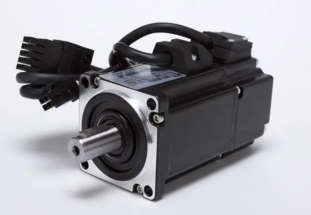
A servo motor refers to an engine that controls the operation of mechanical components in a servo system, and is an indirect variable speed device that supplements the motor. Servo motors can control speed and position accuracy very accurately, and can convert voltage signals into torque and speed to drive control objects. The rotor speed of a servo motor is controlled by input signals and can react quickly. In automatic control systems, it is used as an actuator and has characteristics such as small electromechanical time constant, high linearity, and starting voltage. It can convert the received electrical signal into angular displacement or angular velocity output on the motor shaft. It is divided into two categories: DC and AC servo motors. Its main feature is that when the signal voltage is zero, there is no self rotation phenomenon, and the speed decreases uniformly with the increase of torque.
Working principle of servo motor
1. A servo system is an automatic control system that enables the output controlled variables such as the position, orientation, and state of an object to follow any changes in the input target. Servo mainly relies on pulses for positioning. Basically, it can be understood as follows: when a servo motor receives one pulse, it will rotate the corresponding angle of one pulse to achieve displacement. Because servo motors have the function of emitting pulses, they will emit a corresponding number of pulses every time they rotate an angle. This forms a response or closed loop with the pulses received by the servo motor. In this way, the system will know how many pulses have been sent to the servo motor and how many pulses have been received back. In this way, the rotation of the motor can be accurately controlled to achieve precise positioning, which can reach 0.001mm. DC servo motors are divided into brushed and brushless motors. Brushed motors have low cost, simple structure, large starting torque, wide speed range, easy control, and require maintenance. However, maintenance is inconvenient and generates electromagnetic interference, which has environmental requirements. Therefore, it can be used in cost sensitive general industrial and civilian applications. Brushless motors have small size, light weight, high output, fast response, high speed, low inertia, smooth rotation, and stable torque. The control is complex and easy to achieve intelligence. Its electronic commutation method is flexible and can be square wave commutation or sine wave commutation. The motor is maintenance free, highly efficient, operates at low temperatures, emits minimal electromagnetic radiation, has a long lifespan, and can be used in various environments.
2. AC servo motors are also brushless motors, divided into synchronous and asynchronous motors. Currently, synchronous motors are generally used in motion control, which have a large power range and can achieve high power. High inertia, low maximum rotational speed, and rapidly decreases with increasing power. Therefore, it is suitable for applications that operate smoothly at low speeds.
3. The rotor inside the servo motor is a permanent magnet, and the U/V/W three-phase electricity controlled by the driver forms an electromagnetic field. The rotor rotates under the action of this magnetic field. At the same time, the encoder provided by the motor feeds back the signal to the driver, and the driver compares the feedback value with the target value to adjust the angle of rotor rotation. The accuracy of servo motors is determined by the accuracy of encoders. The functional difference between AC servo motor and brushless DC servo motor: AC servo is better because it is controlled by sine wave and has less torque ripple. DC servo is a trapezoidal wave. But DC servo is relatively simple and cheap.
servo motor ,Gear motor,electric machinery
Address: No.66 bis, Hetong Road, Dongfeng Town, Zhongshan City, Guangdong Province
Tel:0760-22189558
Mobile:13923325827

©2023 GUANGDONG YONGKUN MOTOR CO.,LTD All rights reserved


