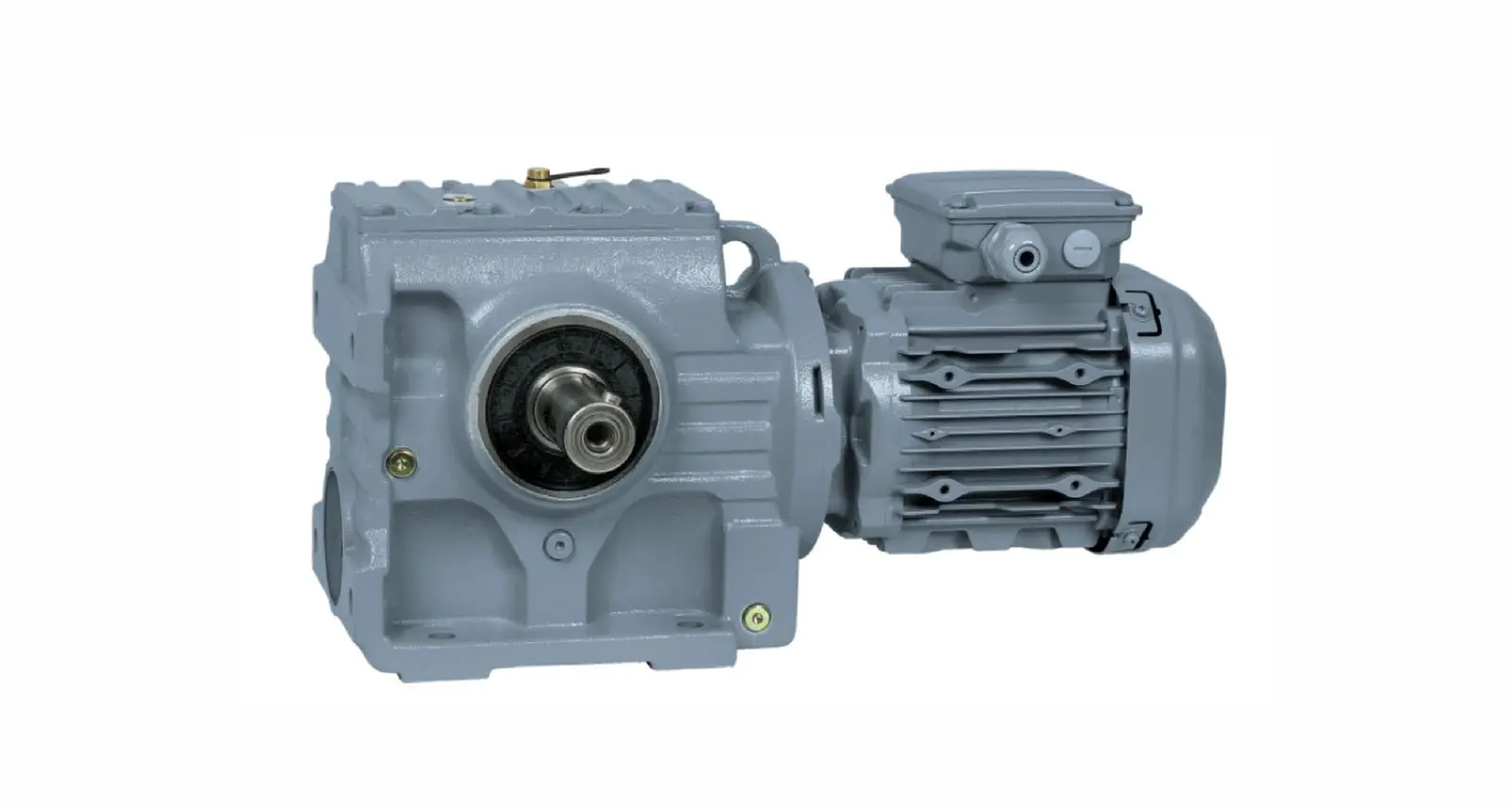
The worm gear principle of the S series reducer
Release Time :
2024-11-12
Source :
metwork
Author:
Made by Guangdong Yongkun Motor Co., Ltd
The worm gear transmission principle in the S series reducer is one of its core working mechanisms. Worm gear is composed of a worm and a worm wheel, which mesh with each other to achieve the functions of deceleration and torque increase.
The worm has a helical tooth surface, which matches the teeth of the worm wheel. When the motor drives the worm gear to rotate, the helical tooth surface interacts with the tooth surface of the worm wheel. Due to the different angles of the two tooth surfaces, the rotational motion of the worm gear is converted into circular motion of the worm wheel, while achieving a decrease in speed and an increase in torque.
The working principle of worm gear has the following characteristics:
Self locking function: Under certain conditions, the worm gear has self-locking properties, that is, the worm cannot drive the worm wheel to rotate, which is beneficial for preventing reverse motion in certain applications.
Large reduction ratio: The helix angle of the worm gear is small, so the reduction ratio of the worm gear is usually large, which can reach 10:1 or even higher.
Low noise: The worm gear meshes smoothly and has a relatively low sliding speed, resulting in low noise during operation.
Smooth transmission: Due to the large meshing area between the worm and worm gear, the load distribution is even during the transmission process, making the transmission smoother.
High maintenance requirements: The meshing of worm gears and worms requires good lubrication to reduce wear and extend service life.
In summary, the worm gear principle of the S series reducer is to achieve efficient and smooth reduction transmission through the interaction of spiral tooth surfaces, which is suitable for situations that require large reduction ratios and reliable transmission.
Worm gear reducer,S series reducer,Gear reducer
Address: No.66 bis, Hetong Road, Dongfeng Town, Zhongshan City, Guangdong Province
Tel:0760-22189558
Mobile:13923325827
©2023 GUANGDONG YONGKUN MOTOR CO.,LTD All rights reserved


