
Mechanical Fundamentals | In Depth Analysis of Worm Gear Reducer Explanation
Release Time :
2025-02-18
Source :
network
Author:
Yongkun Motor
Mechanical Fundamentals | In Depth Analysis of Worm Gear Reducer Explanation
Among various types of reducers, worm gear reducers are a common type of reducer. Worm gear reducer is a power transmission mechanism that uses a gear speed converter to reduce the number of rotations of an electric motor (motor) to the desired number of rotations and obtain a larger torque.
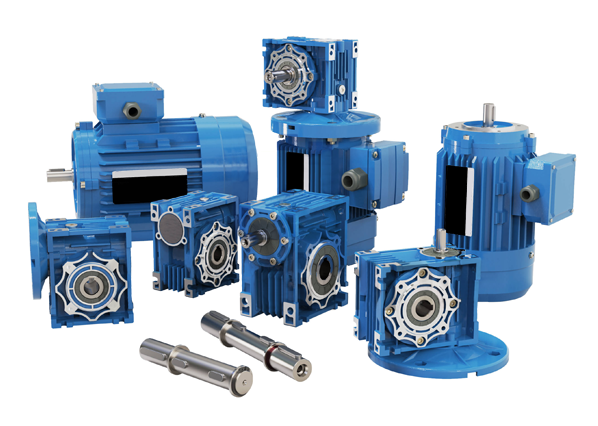
It is mainly composed of transmission components such as worm gears, shafts, bearings, housings, and their accessories. It can be seen in the transmission systems of various types of machinery, from ships, cars, locomotives in transportation, heavy machinery used in construction, processing tools and automated production equipment used in the machinery industry, to common household appliances, clocks and so on in daily life The application of reducers can be seen from the transmission of large power to small loads and precise angle transmission. In industrial applications, reducers have the functions of reducing speed and increasing torque. Therefore, it is widely used in speed and torque conversion equipment.
The basic structure of a worm gear reducer mainly consists of transmission components such as worm gear, shaft, bearings, housing, and accessories. It can be divided into three basic structural parts: housing, worm gear, and bearing shaft combination. The casing is the base of all components in the worm gear reducer, which supports and fixes the shaft components, ensures the correct relative position of the transmission components, and supports the load acting on the reducer. The main function of worm gear is to transmit motion and power between two intersecting shafts, while the main function of bearings and shafts is to transmit power, operate, and improve efficiency.
Knowledge of worm gear reducer
efficiency
Due to the high loss of sliding friction generated by worm gear reducers, compared to helical gears, bevel gear reducers with hard tooth surfaces have higher losses and lower efficiency, mainly determined by the following factors:
Transmission ratio of helical gear worm gear stage
Input speed
The efficiency of the worm gear reducer designed by RISCO for gearbox temperature is significantly improved compared to single-stage worm gear reducers, and it is only possible for the efficiency of worm gear reducers with large speed ratios to be less than 0.5.
Self-locking condition
Applying reverse torque to a helical gear worm gear will generate a reverse efficiency of η '=2-1/η, which is significantly lower than the forward efficiency of η. If the forward efficiency of η ≤ 0.5, the worm gear reducer will self lock. Only a small number of high speed ratio worm gear reducers have static self-locking. If you want to utilize the characteristics of self-locking braking effect, please consult our company
Initial stage of operation
Due to the uneven tooth surface and large friction angle of the new worm gear reducer, the efficiency is lower than normal operation, and this effect becomes more pronounced at high transmission ratios.
Agitation loss
In some installation positions, the first stage small gear is completely immersed in oil. For large mount reducers and reducers with higher input speeds, the agitation loss will sharply increase and cannot be ignored. Therefore, when encountering such situations, please consult our company Demai Transmission.
NMRV gearbox,Worm gear reducer,Reducer
Address: No.66 bis, Hetong Road, Dongfeng Town, Zhongshan City, Guangdong Province
Tel:0760-22189558
Mobile:13923325827

©2023 GUANGDONG YONGKUN MOTOR CO.,LTD All rights reserved


