
Servo motor: making humanoid robots move with excitement
Release Time :
2025-03-02
Source :
network
Author:
Yongkun Motor
Servo motor: making humanoid robots move with excitement
In the current era of rapid technological development, humanoid robots have become the focus of global attention. They integrate cutting-edge technologies from multiple fields such as artificial intelligence, mechanical engineering, and materials science, and are integrating into human life in an unprecedented manner, reshaping the development pattern of various industries.
In the field of industrial manufacturing, humanoid robots, with their flexible limb movements and precise operational capabilities, can undertake tasks such as precision assembly and quality inspection on complex production lines, greatly improving production efficiency and product quality, and reducing labor costs. For example, in electronic device manufacturing, humanoid robots can accurately install tiny electronic components onto circuit boards, avoiding errors that may occur during manual operations.
In the healthcare industry, humanoid robots can serve as nursing assistants, assisting medical staff in caring for patients and carrying out daily nursing work, such as helping patients turn over, medication reminders, rehabilitation training assistance, etc. For patients with mobility difficulties, robots can also provide physical support to assist them in walking exercises, effectively reducing the workload of medical staff and improving the efficiency and quality of medical services.
In the field of education, humanoid robots have also demonstrated unique advantages. It can serve as a personalized educational partner, providing customized learning plans based on students' learning progress and characteristics, and stimulating students' interest in learning. For example, in language learning, robots can engage in real-time conversations with students, correct pronunciation, simulate various real-life scenarios, and enhance students' language abilities through interaction.
However, regardless of the field in which humanoid robots are applied, the core of achieving their flexible and precise movements cannot be separated from servo motors. The servo motor, a seemingly ordinary but powerful device, is like the "muscles" and "joint commanders" of a humanoid robot, silently driving every movement of the robot, enabling it to complete difficult tasks in various complex environments. So, how does a servo motor achieve all of this? What are its working principles and unique advantages?
Servo motor: the "power heart" of humanoid robots
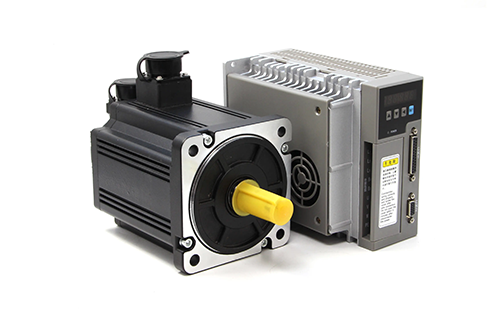
Servo motors, as the core components of joint motion control in humanoid robots, are like human muscles, endowing robots with dynamic "vitality". Its working principle is based on the law of electromagnetic induction, which can accurately convert electrical signals into mechanical motion, achieve precise control of robot joint position, speed, and torque, and thus achieve complex multi degree of freedom motion.
How to accurately control joint motion with servo motor
(1) Closed loop control: the secret to precision
The key to the precise control of joint motion in humanoid robots by servo motors is the adoption of closed-loop control technology. Closed loop control is like installing a pair of "eyes" on the joint motion of a robot, monitoring and adjusting the motion status in real time to ensure that every action is accurate and error free.
In a closed-loop control system, the servo motor and encoder work closely together. The encoder is like a precise "position recorder" that can monitor the rotational position and speed of the motor shaft in real time, and feed back this information to the controller in the form of electrical signals. The controller plays the role of a "commander", comparing and analyzing the received feedback signals with the preset target position and speed. Once a deviation is found between the actual value and the target value, the controller will quickly calculate the amount that needs to be adjusted and issue corresponding control signals. The current, voltage, and other parameters of the servo motor will be adjusted through the driver to change the motor's speed and direction, causing the robot joints to move towards the target position.
Taking the bending action of a robot arm as an example, when the arm needs to bend to a 90 degree position, the controller will send corresponding commands to the servo motor. The motor starts to rotate, driving the joint movement of the arm. At the same time, the encoder monitors the rotation angle of the motor in real time and feeds back the data to the controller. If the actual bending angle of the arm deviates from the target value due to external interference or other factors during the movement, such as an actual angle of 85 degrees, the controller will immediately calculate the deviation based on the feedback signal and adjust the operating parameters of the motor to continue rotating until the arm is accurately bent to a position of 90 degrees, achieving precise control.
This closed-loop control technology greatly improves the accuracy and stability of servo motor control, enabling it to accurately complete various tasks in complex environments and providing strong guarantees for the efficient operation of robots.
servo motor,speed motor,Reducer
Address: No.66 bis, Hetong Road, Dongfeng Town, Zhongshan City, Guangdong Province
Tel:0760-22189558
Mobile:13923325827

©2023 GUANGDONG YONGKUN MOTOR CO.,LTD All rights reserved


