
Control Implementation Method of Stepper Motor
Release Time :
2025-03-03
Source :
network
Author:
Yongkun Motor
Control Implementation Method of Stepper Motor
Stepper motor, as an electric motor that converts electrical pulse signals into corresponding angular displacement or linear displacement, is an indispensable and important component in modern digital control systems. Its working principle is based on electromagnetic principles. By receiving digital control signals (electrical pulse signals) and converting them into mechanical displacements, stepper motors can achieve high-precision position and speed control. This article will provide a detailed introduction to the control implementation method of stepper motors, including basic control principles, common control strategies, and precautions in practical applications.
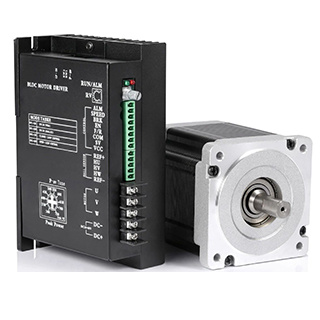
1、 Basic control principle of stepper motor
Stepper motor, also known as pulse motor, is characterized by its precise rotation of the rotor by a fixed angle (step angle) or forward movement by a fixed distance with each input pulse signal. The output displacement (angular displacement or linear displacement) is proportional to the number of pulses input, while the rotational speed is proportional to the pulse frequency. This characteristic makes stepper motors very suitable for applications that require precise position and speed control, such as 3D printing, CNC machine tools, robots, etc.
The working principle of a stepper motor is based on the principle of an electromagnet. By changing the sequence, frequency, and quantity of electrical pulses on the motor coil, precise control of the steering, speed, and rotation angle of the stepper motor can be achieved. The control system of a stepper motor usually includes a pulse signal generator (such as a microcontroller, PLC, etc.), a stepper motor driver, and the stepper motor itself. The pulse signal generator is responsible for generating control pulses, while the stepper motor driver is responsible for receiving these pulse signals and controlling the operation of the stepper motor.
2、 Common control strategies for stepper motors
1. Single step control mode
The single step control method is the most basic control method for stepper motors, which controls the rotation of the motor by controlling its phase sequence. Every time a pulse signal is input, the motor will rotate a certain angle. This control method is simple and direct, suitable for situations where control accuracy is not high and only basic rotational functions need to be achieved.
2. Microstep control method
The micro step control method is developed on the basis of single step control, which divides the rotation angle of each stepper motor into smaller steps to achieve more precise control. Normally, the micro step control method can divide the rotation angle of a stepper motor into 200 or 400 micro steps. This control method can significantly improve the control accuracy of the motor, reduce vibration and noise during rotation, and is suitable for situations that require high-precision positioning and smooth operation.
3. Vector control method
Vector control is a complex stepper motor control method that achieves motor rotation by controlling the current and voltage of the motor. This control method can achieve precise control of motor torque and speed, and is suitable for applications with high performance and reliability requirements. However, the implementation of vector control is relatively complex, requiring precise motor mathematical models and complex control algorithms.
4. Closed loop control mode
Closed loop control is a feedback control method that achieves precise control of the motor by monitoring its rotational status in real-time and adjusting the control signal based on the monitoring results. This method can greatly improve the control accuracy and stability of the motor, and is suitable for situations that require extremely high control accuracy. However, the implementation cost of closed-loop control is high and requires additional sensors and control systems to support it.
5. Pulse direction control method
The pulse direction control method is a simple stepper motor control method that controls the rotation of the motor by controlling the pulse and direction signals of the motor. This method is usually used in some simple application scenarios, such as printers, POS machines, etc. The pulse direction control method is simple to implement and cost-effective, but the control accuracy is relatively low.
stepping motor,Reducer,speed motor
Address: No.66 bis, Hetong Road, Dongfeng Town, Zhongshan City, Guangdong Province
Tel:0760-22189558
Mobile:13923325827

©2023 GUANGDONG YONGKUN MOTOR CO.,LTD All rights reserved


