
Exploring stepper motors: the mystery of precise driving
Release Time :
2025-03-13
Source :
network
Author:
Yongkun Motor
Exploring stepper motors: the mystery of precise driving
1、 Introduction to stepper motor
Stepper motors are widely used in equipment such as printers and embroidery machines in work and life. They can perform positioning control and have high torque at low speeds, making them suitable for situations where positioning accuracy is not particularly high.
In practical applications, the mechanical systems of many devices do not require or are not suitable for high-speed operation. A stepper motor can meet application requirements at a speed of several hundred revolutions per minute. For example, in some situations where positioning accuracy, heat generation, and noise are not particularly high requirements, such as printers, embroidery machines, engraving machines, dispensing machines, and other equipment are all driven by stepper motors.
This is because stepper motors have unique advantages.
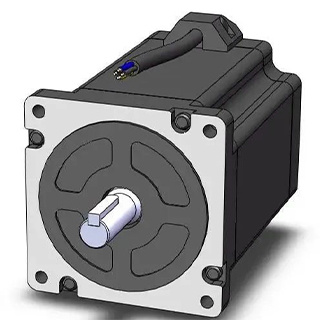
The structure of a stepper motor is relatively simple, similar to a brushless DC motor, but it cannot be directly driven by a DC power supply. It needs to be paired with a stepper driver and pulses need to be sent to the stepper driver before it can operate.
A stepper motor is a type of motor that converts electrical pulses into angular or linear displacement. It can be understood that when a control device such as a PLC or microcontroller sends a pulse signal, the stepper motor operates at a fixed angle under the push of the stepper driver, which is called the step angle. Therefore, stepper motors are also known as pulse motors, and their rotation runs step by step at a fixed angle. If the stepper driver receives a series of pulse signals, it controls the stepper motor to run continuously for a corresponding distance. That is to say, the number of pulses sent can determine the distance traveled by the stepper motor. Controlling the frequency of pulses sent by the control device can also control the speed of the motor, thereby achieving accurate positioning.
But the control of a stepper motor is an open-loop control system. What is open-loop? It refers to a stepper motor, which means it rotates when given a pulse. In fact, the control equipment does not know how many steps have been taken and how many pulses have been lost, so stepper motors are very prone to step loss. Without an encoder for feedback, the actual number of pulses taken cannot be fed back, so the control accuracy of stepper motors is limited.
2、 Structure and working principle of stepper motor
(1) Structure Introduction
Stator: The stator part of a stepper motor is a coil wound around the stator slot of the motor, also known as a winding or phase. The stator is mainly responsible for generating a magnetic field and interacting with the rotor to operate the motor.
Rotor: a part that can rotate around the center, which can be divided into reactive, permanent magnet, and hybrid types according to the type of rotor.
The reactive rotor is composed of soft magnetic materials, with a simple structure, low cost, and small step distance. However, its dynamic performance is relatively poor, efficiency is low, heat generation is high, and reliability is difficult to guarantee. It is now rarely used.
The rotor of a permanent magnet stepper motor is made of permanent magnet material, and the number of poles of the rotor is the same as that of the stator. Its characteristics are good dynamic performance and large output torque, but this type of motor has poor accuracy, large volume, and is currently rarely used.
The hybrid stepper motor combines the advantages of reactive and permanent magnet systems. The rotor is made of permanent magnet material, and there are many small teeth on both the rotor and stator to improve the accuracy of the step pitch. Currently, almost all stepper motors on the market are hybrid stepper motors.
stepping motor,Reducer,gear motor
Address: No.66 bis, Hetong Road, Dongfeng Town, Zhongshan City, Guangdong Province
Tel:0760-22189558
Mobile:13923325827

©2023 GUANGDONG YONGKUN MOTOR CO.,LTD All rights reserved


