
Worm gear transmission in mechanical transmission
Release Time :
2025-03-17
Source :
network
Author:
Yongkun Motor
Worm gear transmission in mechanical transmission
Worm gear transmission is composed of a worm and a worm wheel, used to transmit motion and power between intersecting shafts, usually with a 90 ° angle between the two shafts. In general worm gear transmission, the worm gear is used as the active component.
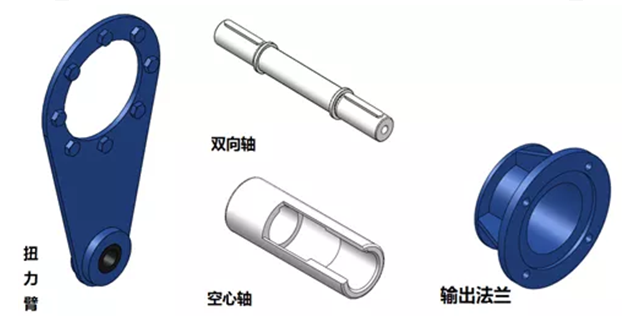
From the appearance, the worm is similar to a bolt, while the worm wheel is very similar to a helical cylindrical gear.
During operation, the worm gear teeth slide and roll along the helical surface of the worm.
Worm gear refers to a gear that has one or several helical teeth and meshes with a worm wheel to form a staggered shaft gear pair. The indexing surface can be cylindrical, conical, or toroidal.
There are four categories: Archimedean worm, involute worm, normal profile worm, and conical enveloping cylindrical worm.
Worm gears, like threads, can be divided into right-handed and left-handed, respectively referred to as right-handed worm gears and left-handed worm gears.
In order to improve the contact between the gear teeth, the worm wheel is made into a circular arc shape along the tooth width direction, so that it wraps around the worm part. In this way, when the worm gear and worm wheel mesh, it is in line contact rather than point contact.
Advantages of worm gear transmission
Single stage transmission ratio is large, generally i=10~100. In the indexing mechanism that transmits power, the maximum can reach over 1500.
The same mesh is in linear contact and can withstand significant power.
Compact structure, smooth transmission, and low noise.
When the worm gear lift angle is less than the equivalent friction angle between the gears, it has reverse stroke self-locking, that is, only the worm gear can drive the worm wheel, and the worm wheel cannot drive the worm gear.
Disadvantages of worm gear transmission
The two axes are perpendicular, and the linear velocity of the two wheel nodes is perpendicular, so the relative sliding speed is high, which is prone to heating and wear.
Low efficiency, generally ranging from 0.7 to 0.8; Worm gears with self-locking properties have lower efficiency, generally less than 0.5.
Calculation formulas for worm gears and worm gears
1. Transmission ratio=number of worm gear teeth ÷ number of worm heads
2. Center distance=(worm gear pitch diameter+worm gear pitch diameter) ÷ 2
3. Worm gear roar diameter=(number of teeth+2) x module
4. Worm gear pitch diameter=module x number of teeth
5. Worm pitch diameter=worm outer diameter -2 × module
6. Worm lead=π x modulus x number of heads
7. Spiral angle (lead angle) tgB=(module x number of heads) ÷ worm pitch diameter
8. Worm lead=π x modulus x number of heads
9. Modulus=dividing circle diameter/number of teeth
Number of worm heads: single head worm (there is only one spiral line on the worm, that is, when the worm rotates once, the worm wheel rotates one tooth); Double headed worm gear (with two spiral lines on the worm gear, i.e. the worm gear rotates one turn and the worm wheel rotates two teeth).
Modulus refers to the size of the helix on the screw, meaning that the larger the modulus, the larger the helix on the screw;
The diameter coefficient refers to the thickness of the screw.
Modulus: The pitch circle of a gear is the reference for designing and calculating the dimensions of each part of the gear, and the circumference of the gear pitch circle=π d=zp, so the diameter of the pitch circle
d=z p/π
Due to π being an irrational number in the above equation, it is not convenient to use it as a reference for locating the graduation circle. For the convenience of calculation, manufacturing, and inspection, the ratio p/π is now artificially defined as some simple numerical values, and this ratio is called a module, represented by m.
worm gear reducer,Reducer,electrical machinery
Address: No.66 bis, Hetong Road, Dongfeng Town, Zhongshan City, Guangdong Province
Tel:0760-22189558
Mobile:13923325827

©2023 GUANGDONG YONGKUN MOTOR CO.,LTD All rights reserved


