
Detailed explanation of worm gear transmission principle, essential for robots
Release Time :
2025-03-18
Source :
network
Author:
Yongkun Motor
Detailed explanation of worm gear transmission principle, essential for robots
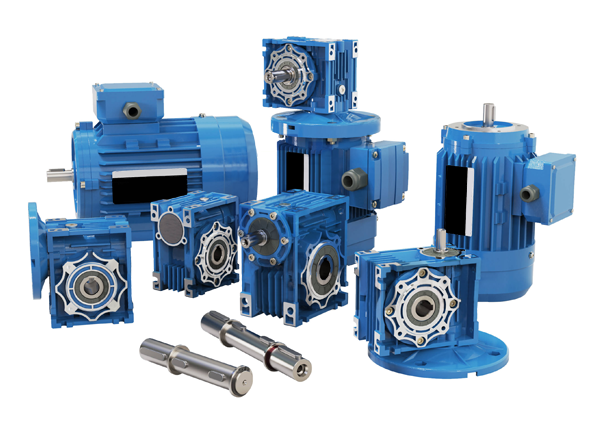
Worm gear transmission is a type of transmission that transfers motion and power between two axes that are spatially staggered. The angle between the two axes can be any value, and the commonly used one is 90 °. Worm gear transmission is used to transmit motion and power between intersecting shafts.
1. Introduction
Worm gear transmission consists of a worm and a worm wheel, with the worm generally being the active component. Worm gears, like threads, can be divided into right-handed and left-handed worm gear transmissions, known as right-handed worm gears and left-handed worm gears, respectively. A worm with only one spiral line on it is called a single head worm, which means that when the worm rotates one revolution, the turbine rotates one tooth. If there are two spiral lines on the worm, it is called a double head worm, which means that when the worm rotates one revolution, the turbine rotates two teeth.
2. Characteristics
(1) High transmission ratio and compact structure. The number of worm heads is represented by Z1 (usually Z1=1-4), and the number of worm gear teeth is represented by Z2. From the transmission ratio formula I=Z2/Z1, it can be seen that when Z1=1, that is, the worm gear is a single head, the worm gear needs to rotate Z2 to rotate the worm gear, thus obtaining a large transmission ratio. Generally, in power transmission, the transmission ratio I=10-80 is taken; In the indexing mechanism, I can reach 1000. Such a large transmission, such as gear transmission, requires multi-stage transmission, so worm gear transmission has a compact structure, small volume, and light weight.
(2) The transmission is smooth and noiseless. Because the worm gear teeth are continuous and uninterrupted spiral teeth, they mesh continuously with the worm gear teeth without entering or exiting the meshing process, resulting in smooth operation and relatively low impact, vibration, and noise.
(3) It has self-locking properties. When the helix angle of the worm is very small, the worm can only drive the worm wheel for transmission, and the worm wheel cannot drive the worm to rotate.
(4) Worm gear transmission has low efficiency, and it is generally believed that worm gear transmission has lower efficiency than gear transmission. Especially with self-locking worm gear transmission, its efficiency is below 0.5, and the general efficiency is only 0.7-0.9.
(5) High heat generation, easy wear of tooth surfaces, and high cost.
Structure Introduction
Generally, the worm gear is integrated with the shaft and is called a worm shaft. The structural types of worm gears can be divided into three forms: worm gear transmission Integral: Used for cast iron and small diameter bronze worm gears Gear ring press fit type: The hub is made of cast iron or steel, and the rim is made of bronze Bolt connection type: The wheel rim and hub are hinged with holes and connected by bolts, making this structure easy to assemble and disassemble.
Transmission application
Worm gear transmission is commonly used in situations where two shafts are interlocked, the transmission ratio is large, the transmitted power is not very large, or intermittent work is performed.
When a large power is required to be transmitted in worm gear transmission, Z1=2-4 is often taken to improve transmission efficiency. In addition, due to the self-locking nature of the transmission when γ 1 is small, it is commonly used in lifting machinery such as winches to provide safety protection. It is also widely used in machine tools, automobiles, instruments, metallurgical machinery, and other machines or equipment, because the use of wheel axle motion can reduce the consumption of force, thus promoting it vigorously.
NMRV worm gear reducer,Reducer,worm gear reducer
Address: No.66 bis, Hetong Road, Dongfeng Town, Zhongshan City, Guangdong Province
Tel:0760-22189558
Mobile:13923325827

©2023 GUANGDONG YONGKUN MOTOR CO.,LTD All rights reserved


