
From Principle to Application: Analysis of the Relationship between Stepper Motor and Driver
Release Time :
2025-03-20
Source :
network
Author:
Yongkun Motor
From Principle to Application: Analysis of the Relationship between Stepper Motor and Driver
A stepper motor is an actuator that converts electrical pulses into angular displacement. Simply put, when a stepper driver receives a pulse signal, it drives the stepper motor to rotate a fixed angle (and step angle) in the set direction. You can control the angular displacement by controlling the number of pulses to achieve accurate positioning; At the same time, you can control the speed and acceleration of the motor rotation by controlling the pulse frequency, thus achieving the purpose of speed regulation.
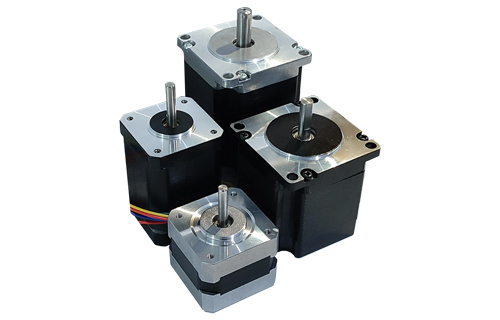
What is the step angle of a stepper motor?
A pulse signal is an electrical signal in which the voltage repeatedly changes between ON and OFF. Each ON/OFF cycle is recorded as a pulse. A single pulse signal command causes the motor output shaft to rotate one step. A single pulse signal command causes the motor output shaft to rotate one step.
Classification of stepper motors
At present, commonly used stepper motors include two-phase stepper motors, three-phase stepper motors, and five phase stepper motors: the step angle of two-phase stepper motors is generally 1.8 ° or 0.9 °; The step angle of a three-phase stepper motor is generally 1.2 °; The step angle of a five phase stepper motor is generally 0.72 °.
A two-phase stepper motor with a step angle of 1.8 ° requires 200 steps to rotate once:
360 °/1.8 °=200 steps
The 1.8 ° step angle is called the "inherent step angle" of the stepper motor, but it may not be the true "step angle" of the motor's actual operation. The true "step angle" is related to the subdivision of the stepper motor's driver.
What is driver segmentation?
Before the subdivision of drivers, users generally used stepper motors with different numbers of phases to meet their requirements for step angle. After using the subdivision driver, the "phase number" becomes meaningless. Users only need to change the subdivision number on the stepper motor driver to change the pulse equivalent (the angle of rotation of the pulse motor).
Subdivision is the process in which the driver controls the motor by dividing each full pulse emitted by the upper computer by the subdivision factor set by the driver. Simply put, it is to reduce the step angle of the motor according to the subdivision ratio.
For example, for a stepper motor with a step angle of 1.8 ° and a driver subdivision set to 32, the pulse equivalent is 18 °/32=0.05625 °
It can also be understood as 200 pulses per revolution without driver subdivision settings; When the subdivision is set to 32, the stepper motor driver needs to output 6400 pulses of 200 * 32 to complete one revolution of the stepper motor.
Wiring between stepper motor and driver
Pulse signal is connected to PUL+, direction signal is connected to DIR+(direction signal output rotates forward when high level is high, and reverses when low level is low), PUL-DIR - is connected to the ground of the power supply, EN+EN - is the release enable, no wiring is required
Attention: The output power supply of the PLC is 24V. Try to find a motor driver that outputs 24V. If the output is 5V, be sure to use a series resistor to regulate the voltage
speed motor,Micro speed regulating motor,stepping motor
Address: No.66 bis, Hetong Road, Dongfeng Town, Zhongshan City, Guangdong Province
Tel:0760-22189558
Mobile:13923325827

©2023 GUANGDONG YONGKUN MOTOR CO.,LTD All rights reserved


