
Braking principle and clearance adjustment of three-phase brake motor
Release Time :
2025-04-03
Source :
network
Author:
Yongkun Motor
Braking principle and clearance adjustment of three-phase brake motor
In the field of automated driving, three-phase brake motors are widely used due to their high efficiency, stability, and reliability. The brake motor not only runs smoothly, but also responds quickly when stopped. Its braking performance is related to the stability and safety of the equipment, effectively ensuring precise control and safe operation of the equipment. This article will deeply explore the braking principle of three-phase brake motors and analyze in detail the methods of adjusting brake clearance, mainly providing reference for technical personnel and users in related fields.
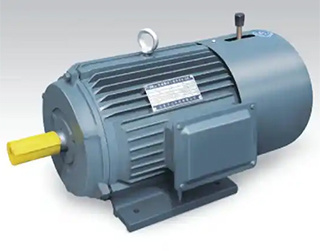
Braking principle
The braking principle of three-phase brakes mainly relies on the interaction between electromagnetic brakes and springs. The electromagnetic brake contains an electromagnet (also known as an excitation coil) inside. When the motor operates, its braking system mainly includes key components such as the electromagnet, brake pads, springs, and rectifier. When the motor is powered on, the electromagnetic brake synchronously powers on and generates a magnetic field, which attracts the brake pads inside the brake and separates them from the rotating part of the motor. At this moment, the motor can rotate freely. When the motor loses power, the electromagnetic brake also loses power, the magnetic field disappears, and the reset mechanism of the brake pad (such as the spring) will push the brake pad to touch the rotating part of the motor, generating friction and achieving braking. During this process, the three-phase current of the motor is connected in parallel with any two input terminals of the motor through the two AC input terminals of the rectifier.
In addition, the three-phase brake motor also has multiple braking modes, such as power on braking and power-off braking. As the name suggests, 1. Power on brake: brake when the motor is powered on. 2. Power off brake: brake when the motor is powered off. Commonly used in the market is power-off braking. If the customer adjusts the frequency too high or too low while using a frequency converter, it is recommended to wire the brake rectifier separately. Avoid brake failure caused by unstable current.
gap adjustment
The adjustment of brake clearance is crucial for the braking performance of the motor, as excessive or insufficient clearance can affect the braking effect of the motor. The following is the detailed process for adjusting the brake clearance: Firstly, it is necessary to confirm that the motor has been powered off to prevent safety accidents during the adjustment process, and prepare the necessary tools such as a Phillips screwdriver, feeler gauge, hexagon socket, etc. The first step is to remove the motor fan cover. After removing the fan cover, loosen the fixing screw on the upper end of the brake. The second part uses a feeler gauge to calibrate the gap between the brake pads and the electromagnet, and adjust it according to the manufacturer's standard gap. After adjustment, tighten the screws. Reinstall the motor and connect it to the power supply for testing, observing whether the motor's braking is timely and effective. Based on the test results, further fine tune the brake clearance until it reaches the optimal state.
The adjustment of brake clearance is crucial for the braking performance of the motor, as excessive or insufficient clearance can affect the braking effect of the motor. The following is the detailed process for adjusting the brake clearance: Firstly, it is necessary to confirm that the motor has been powered off to prevent safety accidents during the adjustment process, and prepare the necessary tools such as a Phillips screwdriver, feeler gauge, hexagon socket, etc. The first step is to remove the motor fan cover. After removing the fan cover, loosen the fixing screw on the upper end of the brake. The second part uses a feeler gauge to calibrate the gap between the brake pads and the electromagnet, and adjust it according to the manufacturer's standard gap. After adjustment, tighten the screws. Reinstall the motor and connect it to the power supply for testing, observing whether the motor's braking is timely and effective. Based on the test results, further fine tune the brake clearance until it reaches the optimal state.
It should be noted that professional tools and equipment should be used during the adjustment process to ensure the quality of maintenance. When carrying out motor maintenance, it is essential to follow safety operating procedures to avoid safety accidents. Regularly check the brake status and promptly repair any problems to extend the service life of the brakes.
gear motor,Reducer,electrical machinery
Address: No.66 bis, Hetong Road, Dongfeng Town, Zhongshan City, Guangdong Province
Tel:0760-22189558
Mobile:13923325827

©2023 GUANGDONG YONGKUN MOTOR CO.,LTD All rights reserved


