Research on the Principle, Function and Technical Application of Harmonic Reducer
Release Time :
2025-04-19
Source :
network
Author:
Yongkun Motor
Research on the Principle, Function and Technical Application of Harmonic Reducer
Harmonic reducer, as a high-precision transmission device based on the principle of elastic deformation, has been widely used in fields such as robotics, aerospace, and precision instruments due to its large reduction ratio, high precision, and compact structure. This article starts from the core principle of harmonic reducers, analyzes in detail their structural composition, working process, and dynamic characteristics, explores their functional advantages and technical challenges in combination with practical application scenarios, and puts forward prospects for future development directions.
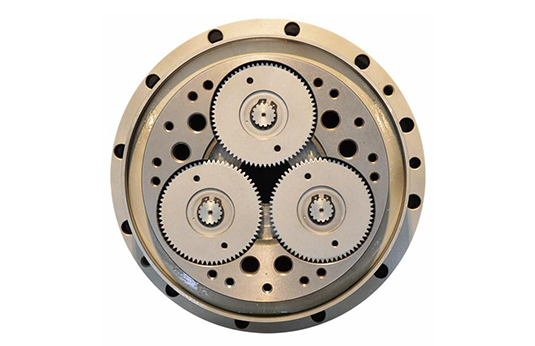
With the rapid development of industrial automation and robotics technology, the limitations of traditional gear transmission in terms of accuracy, volume, and efficiency are becoming increasingly prominent. Harmonic Drive was invented by American inventor C W. Musser proposed in 1955 that it achieved power transmission through the elastic deformation of flexible gears, becoming a revolutionary technology in the field of precision transmission. The high-precision characteristics of harmonic reducers make them irreplaceable in scenarios such as joint control of humanoid robots and satellite antenna drive. In addition, its localization breakthrough has strategic significance for reducing the cost of high-end equipment and enhancing the independent controllability of the industrial chain.
Working principle of harmonic reducer
Core components and functions
The harmonic reducer consists of three key components (Figure 1):
Wave Generator: A combination of elliptical cam and flexible bearing, used as the power input shaft to force the flexible wheel to undergo periodic deformation.
Flexspline: A thin-walled cup-shaped flexible gear with teeth distributed at the open end, which meshes with a rigid wheel through elastic deformation.
Circular Spline: A rigid internal gear with 2-4 more teeth than a flexible wheel, fixed to the housing or output end.
Motion transmission characteristics
Input output relationship: The wave generator inputs high speed and low torque, while the flexible or rigid wheel outputs low speed and high torque.
Transmission error control: Flexible meshing can compensate for assembly errors, and the transmission backlash is less than 1 angular minute.
Application areas of harmonic reducers
1. Robotics Technology
Industrial robotic arm: ABB IRB 6700 series adopts harmonic reducer to achieve wrist ± 0.01 ° repetitive positioning accuracy.
Humanoid robot: Boston Dynamics Atlas robot simulates human motion flexibility through 20 harmonic joints.
2. Aerospace
Satellite antenna drive: The Sentinel satellite of the European Space Agency (ESA) uses harmonic reducers to achieve precise antenna pointing at 0.001 °/s.
Mars rover robotic arm: NASA Perseverance's sampling arm relies on harmonic reducers to operate stably under extreme temperature differences.
3. Medical equipment
Surgical robots such as da Vinci system utilize harmonic reducers to achieve sub millimeter level motion control of minimally invasive surgical instruments.
Harmonic Drive,Precision reducer,Reducer
Address: No.66 bis, Hetong Road, Dongfeng Town, Zhongshan City, Guangdong Province
Tel:0760-22189558
Mobile:13923325827

©2023 GUANGDONG YONGKUN MOTOR CO.,LTD All rights reserved


