
Systematic analysis of core parameters of planetary gearbox
Release Time :
2025-04-24
Source :
network
Author:
Yongkun Motor
Systematic analysis of core parameters of planetary gearbox
In the current era of rapid development of automation equipment, planetary reducers stand out as an essential choice for automation equipment due to their small and exquisite size, ultra-high precision, and excellent efficiency. How to quickly understand the complex parameter meanings and make precise selections? Let's take a look together.
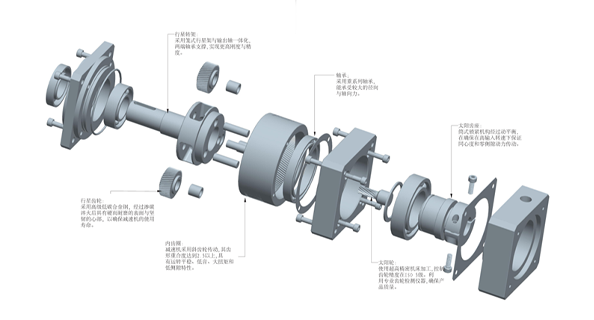
Reduction ratio: Reduce speed and increase torque, for example, if the rated speed of the motor is 3000rpm and the torque is 1.24Nm, then when selecting a reduction ratio of 5 (reduction ratio=motor input speed/reducer output speed), the output speed of the reducer is 600rpm, and the rated output torque at the output end is 6.2Nm (without considering efficiency issues);
The influence of single-stage and two-stage reducers on reduction ratio
The reduction ratio range of a single-stage gearbox is usually narrow, generally between 2-10. This is due to its structural limitations, which only reduce speed through a pair of gears. The gear ratio cannot be too large, otherwise it will cause the gear size to be too large or too small, affecting transmission efficiency and stability. For example, in some small automation equipment, it may only be necessary to reduce the motor speed by a few times to use a single-stage reducer to meet the requirements.
A two-stage gearbox uses two pairs of gears for two-stage reduction, which can achieve a larger reduction ratio than a single-stage gearbox, usually between 10-100. It can reduce the speed of the input shaft through the first stage gear, and then further reduce it through the second stage gear, thereby achieving a higher reduction effect. For example, in equipment such as elevators and cranes that require high torque and low speed, two-stage reducers are often used to achieve reduction ratios of tens or even hundreds of times.
Rated output torque and maximum acceleration torque: Assuming a reduction ratio of 3, the maximum allowable output acceleration torque of the reducer is 30Nm, and the rated output torque is 17Nm. When one of the required parameters exceeds this value, the larger model or other suitable reduction ratio is selected. It needs to be clarified that this is the torque range that the gearbox itself can withstand, and it does not have its own power. The actual output torque is obtained by calculating the selected motor and reduction ratio, referring to the case of reduction ratio;
The relationship between the rated output torque and maximum acceleration torque of the reducer
Rated output torque: It is the torque value that the reducer can continuously and stably output under normal working conditions. It is determined based on factors such as the design parameters, material strength, and transmission efficiency of the gearbox, and is an important indicator for measuring the load-bearing capacity of the gearbox.
Maximum acceleration torque: It is the maximum torque value that the gearbox can output in a short period of time, usually occurring during equipment start-up, acceleration, or sudden loading conditions. The maximum acceleration torque is generally greater than the rated output torque, because in these special working conditions, the gearbox needs to provide greater torque to overcome inertia and resistance, so that the equipment can quickly reach the required speed or withstand sudden increases in load.
The rated output torque reflects the conventional working capacity of the gearbox, while the maximum acceleration torque reflects the overload capacity of the gearbox when dealing with special working conditions. When selecting a reducer, both parameters need to be considered simultaneously to ensure that the reducer can meet the torque requirements of the equipment under normal operation and special working conditions.
Precision reducer,planetary reducer,Reducer
Address: No.66 bis, Hetong Road, Dongfeng Town, Zhongshan City, Guangdong Province
Tel:0760-22189558
Mobile:13923325827

©2023 GUANGDONG YONGKUN MOTOR CO.,LTD All rights reserved


