One article summarizes the types, advantages, disadvantages, and applications of electric motors
Release Time :
2025-04-28
Source :
network
Author:
Yongkun Motor
One article summarizes the types, advantages, disadvantages, and applications of electric motors
What is the difference between brushless motors and brushed motors? What is the difference between synchronous motor and asynchronous motor? Are all servo motors AC motors? Are all servo motors synchronous motors? Do stepper motors belong to DC motors or AC motors? Does the servo motor belong to servo motors, etc
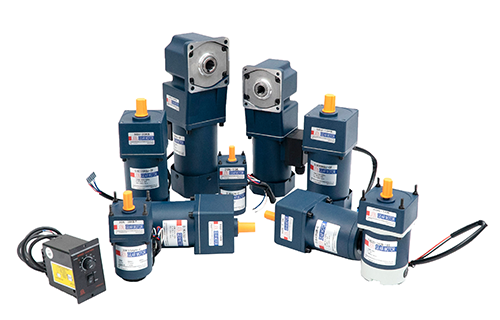
DC motor - brushed motor
Even top and bottom students who have studied high school physics know that in order to study the force acting on an electrified conductor in a magnetic field, we have trained our left hand to a broken palm, which is also the principle of DC motors.
All motors are composed of a stator and a rotor. In a DC motor, in order to make the rotor rotate, the direction of the current needs to be constantly changed. Otherwise, the rotor can only rotate half a turn, which is like a self-propelled motor
Car foot pedal. So DC motors require a commutator.
Broadly speaking, DC motors include brushed motors and brushless motors.
Brushed motor, also known as DC motor or carbon brush motor, commonly refers to a brushed DC motor that uses mechanical commutation. The external magnetic poles do not move, and the internal coils (armature) move. The commutator and rotor coils rotate together, while the brushes and magnets do not move. Therefore, the commutator and brushes rub against each other to complete the switching of current direction.
Disadvantages of brushed motors:
1. The sparks generated by mechanical commutation cause friction between the commutator and the electric brush, electromagnetic interference, high noise, and short lifespan.
2. Poor reliability, frequent failures, and the need for frequent maintenance.
3. Due to the existence of the commutator, the rotor inertia is limited, the maximum speed is restricted, and the dynamic performance is affected.
Since it has so many drawbacks, why is it still widely used? It has high torque, simple structure, easy maintenance (i.e. replacing carbon brushes), and is cheap.
The structure of a brushless motor is the same as that of a permanent magnet synchronous motor.
However, a single brushless motor is not a complete power system, and brushless motors must be controlled by a brushless controller, also known as an electric controller, to achieve continuous operation.
The true determinant of its performance is the brushless electronic speed regulator (also known as ESC).
Generally, there are two types of driving currents for brushless motors, one is square wave and the other is sine wave.
Sometimes the former is called a DC brushless motor and the latter is called an AC servo motor, specifically a type of AC servo motor. (Video Portal)
The operation mode of brushless motors is different, and they can be divided into inner rotor brushless motors and outer rotor brushless motors.
The internal rotors are all three-phase, which is relatively expensive.
The outer rotor is usually single-phase and affordable, and mass production is close to that of carbon brush motors, so it has been widely used in recent years.
The price of the outer rotor three-phase is close to that of the inner rotor.
Well, as you can guess, the disadvantage of brushed motors is that they are a bit lacking compared to brushless motors.
It has the advantages of high efficiency, low energy consumption, low noise, long service life, high reliability, servo control, and stepless variable frequency speed regulation (up to very high speeds). Compared to brushed DC motors, it is much smaller in size, simpler in control than asynchronous AC motors, with large starting torque and strong overload capacity. As for its disadvantages... it is more expensive and difficult to maintain than brushed DC motors.
speed motor,Brushless Motor,gear motor
Address: No.66 bis, Hetong Road, Dongfeng Town, Zhongshan City, Guangdong Province
Tel:0760-22189558
Mobile:13923325827

©2023 GUANGDONG YONGKUN MOTOR CO.,LTD All rights reserved


