
What is a servo motor?
Release Time :
2025-05-16
Source :
network
Author:
Yongkun Motor
What is a servo motor?
Electric motors are mainly used as power sources for continuous rotation of equipment. In contrast, servo motors equipped with control mechanisms can only rotate a fixed angle and stop at precise positions. By utilizing this characteristic, servo motors are widely used in various equipment control scenarios in the industrial and hobby fields, from joint positioning of industrial robots to determining the rudder angle of radio controlled aircraft, their presence is everywhere.
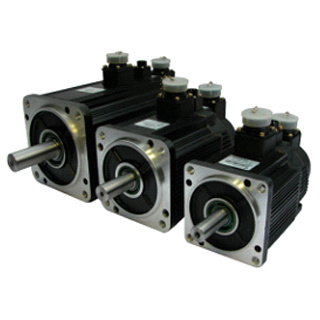
Definition of servo motor
The servo of a servo motor refers to the control mechanism. In the field of technology, the controlling side is called the master, and the controlled side is called the slave. It is said that both servo and slave originate from the Latin word Servus (slave).
That is to say, the name servo motor means a motor that works faithfully according to instructions. As long as it can control the rotational position and speed, any motor with any mechanism is called a "servo motor".
Therefore, sometimes stepper motors and ironless motors are also included in servo motors. Here, we explain the type of servo motor that is equipped with an encoder (rotation detector) and uses a driver to control speed and position (angle) based on this information.
The difference between servo motor and stepper motor
Stepper motors, like servo motors, are equipped with mechanisms that control the rotation angle by receiving external signals. They can both perform equipment positioning and other operations, but have the following differences.
The servo motor detects the rotational position through an encoder (rotation detector) and feeds back the information detected by the encoder to the controller to control the position. Therefore, high-precision stopping can be achieved, even if it stops during rotation, it can return to its original position if there is a deviation in position.
On the other hand, the rotation angle of the stepper motor is proportional to the number of pulses, and the driver controls the position by receiving this pulse signal from the controller. Therefore, in fact, it does not require a mechanism to detect the position, so it cannot identify the deviation of the position.
Torque/RPM
Servo motors can generate stable torque in both low-speed and high-speed regions, thus enabling high-speed operation. Stepper motors are only capable of generating high torque in low-speed regions, and the torque decreases in high-speed regions, making them unsuitable for high-speed rotation applications.
cost
Servo motors are more expensive than stepper motors because they require the use of expensive rotary encoders and servo control devices (servo drivers).
servo motor,electrical machinery,gear motor
Address: No.66 bis, Hetong Road, Dongfeng Town, Zhongshan City, Guangdong Province
Tel:0760-22189558
Mobile:13923325827

©2023 GUANGDONG YONGKUN MOTOR CO.,LTD All rights reserved


