The main uses of the four series of reducers
Release Time :
2025-06-12
Source :
network
Author:
Yongkun Motor
The main uses of the four series of reducers
The four major series of reducers (usually referring to F series parallel axis helical gear reducers, K series spiral bevel gear reducers, R series helical gear reducers, and S series helical gear worm gear reducers) are the most widely used and classic types of universal gear reducers in the industrial field. Their main purpose is to reduce motor speed and increase output torque to meet the power transmission needs of various mechanical equipment.
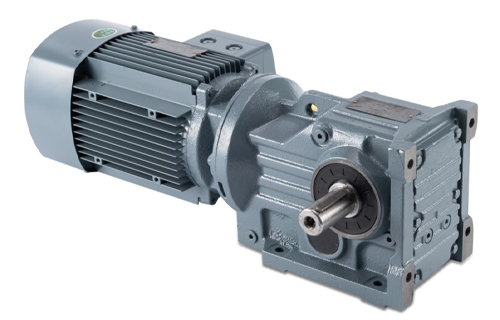
Each series, due to its structural characteristics and performance advantages, has its more focused application areas:
F-series parallel axis helical gear reducer:
Structural features: parallel axis arrangement and multi-stage helical gear transmission. Compact structure, easy installation (especially in the form of direct motor connection), high efficiency, smooth operation, and low noise.
Main purpose:
Conveyor equipment: belt conveyor, roller conveyor, chain plate conveyor, elevator, etc.
General Machinery: Packaging Machinery, Printing Machinery, Food Machinery, Textile Machinery, Woodworking Machinery, etc.
Material handling: mixing equipment, blending equipment, filling equipment, etc.
Medium load applications that require compact structure and smooth operation.
K series spiral bevel gear reducer:
Structural features: The first stage adopts spiral bevel gears (to achieve 90 degree vertical intersecting direction of input and output shafts), and the second stage and subsequent stages adopt parallel shaft helical gear transmission. Combining the advantages of strong directional ability, high load-bearing capacity, high parallel axis gear transmission efficiency, and wide speed ratio range of bevel gears. Sturdy structure and high output torque.
Main purpose:
In situations where overloading and directional switching are required: this is the most prominent advantage of the K series. Such as mixing equipment (vertical mixer), crane walking/rotating mechanism, unloading machine, flipping machine, mining machinery, metallurgical equipment, port machinery, etc.
Agricultural machinery: harvesters, tractor supporting equipment, etc.
Industrial equipment that requires high torque output and spatial direction conversion.
R series helical gear reducer:
Structural features: Adopting a coaxial arrangement (with input and output shafts on the same axis) and multi-stage helical gear transmission. The structure is very compact, saving space, with various installation forms (foot installation, flange installation, shaft installation, etc.), high efficiency, and smooth and quiet operation.
Main purpose:
In situations where space is limited and coaxial transmission is required, this is the core advantage of the R series.
Conveyor technology: various types of conveyor belts and drum drives.
In the general industrial field, it is widely used in almost all mechanical equipment that requires deceleration transmission, such as mixers, extruders, winches, fans, water pumps, etc., in food and beverage, chemical, plastic, rubber, pharmaceutical, environmental protection, logistics sorting, etc.
In situations where high efficiency and low noise are required.
S series helical gear worm gear reducer:
Structural features: Combining helical gears (one or multiple stages) and worm gears (usually the final stage) for transmission. The helical gear provides high primary reduction and efficiency, while the worm gear provides great single-stage reduction ratio and self-locking function (under specific conditions). Compact structure, capable of achieving a very large overall transmission ratio.
Main purpose:
In situations where a large reduction ratio and self-locking function are required: this is the most unique advantage of the S series. Scenes with high safety requirements and the need to prevent load reversal include lifting equipment (lifting platforms, stage machinery, elevator auxiliary drives), tilting equipment (tipping buckets, mixing tanks), rolling shutter doors, gate opening and closing machines, etc.
Equipment with light to moderate loads, intermittent operation, and requiring a large reduction ratio, such as small mixers, indexing mechanisms, and positioning mechanisms in automation equipment.
The requirements for noise are relatively low, but it requires applications with super speed ratios and self-locking.
Summarize the core uses of the four major series of reducers:
Reduce speed and increase torque: The basic function of all reducers is to convert the high speed and small torque of the motor into the low speed and large torque required by the equipment.
Matching power: enable the motor to operate in the high-efficiency zone while meeting the equipment's requirements for speed and force.
Space adaptation: Adapt to the spatial limitations of equipment layout through different structural forms (parallel axis, vertical axis, coaxial).
Special features: Provides specific functions such as direction conversion (K series) and self-locking (S series).
The choice of which series mainly depends on the following factors:
Required torque and power size
Input/output speed requirements (speed ratio)
Requirements for the relative spatial position of the input shaft and output shaft (whether they are parallel, perpendicular, or coaxial)
Do you need self-locking function
Installation space restrictions
Efficiency requirements
Noise requirements
Working system (continuous or intermittent operation)
Cost budget
These four series have become indispensable basic power transmission components to support modern industrial production due to their mature design, high reliability, good interchangeability, and ease of selection and procurement.
Four major series of reducers,Reducer,Hardened reducer
Address: No.66 bis, Hetong Road, Dongfeng Town, Zhongshan City, Guangdong Province
Tel:0760-22189558
Mobile:13923325827

©2023 GUANGDONG YONGKUN MOTOR CO.,LTD All rights reserved


