
Compare mainstream gearbox types to accurately match your application needs
Release Time :
2025-06-19
Source :
network
Author:
Yongkun Motor
Compare mainstream gearbox types to accurately match your application needs
1、 Main types of reducers classified by transmission principle and structure
1. Gear reducer
Principle: Utilizing the meshing of two or more gears to transmit power and change speed/torque.
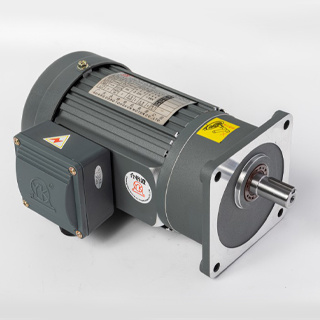
Core differences: the relative position between gear axes (parallel, intersecting, staggered) and gear types (cylindrical spur/helical/herringbone, bevel gear, worm gear).
Main types:
Planetary gear reducer:
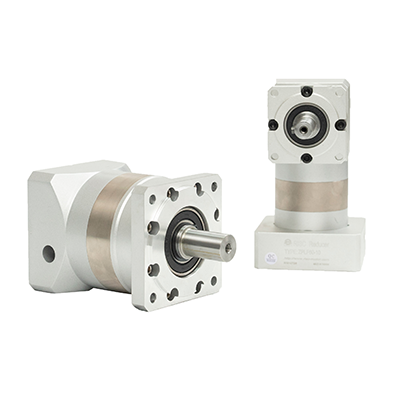
Structure: Composed of a sun gear, multiple planet gears, an inner ring gear, and a planet carrier. The power is usually input to the sun gear, and the planetary gears mesh and roll between the sun gear and the ring gear, with the planetary carrier outputting.
advantage:
High power density/small volume: Power is divided into multiple planetary gears, with high load-bearing capacity and compact structure.
High transmission efficiency: Single stage can reach 97% -98%.
High stiffness/low backlash: Multiple teeth meshing simultaneously, uniform force distribution, high torsional stiffness, precision type can achieve extremely low backlash.
Coaxial input/output: easy to install and layout.
High torque output: particularly suitable for servo motor applications.
Disadvantages:
Complex structure, high manufacturing accuracy requirements, and high cost.
High heat dissipation requirements: A compact structure may result in lower heat dissipation compared to parallel axes.
Repairing is relatively complex.
Applications: servo motor drive, robot joints, precision machine tools, automation equipment, packaging machinery, medical equipment, lifting and transportation, engineering machinery (walking drive), wind power pitch/yaw, applications requiring high precision, high rigidity, and compact space.
Parallel axis gear reducer:
Structure: The input shaft and output shaft axis are parallel, and are reduced by series meshing of multi-stage cylindrical gears (straight teeth, helical teeth, herringbone teeth).
advantage:
Simple and reliable structure, mature technology, easy to manufacture and maintain.
High transmission efficiency: The efficiency of helical/herringbone teeth can reach over 95%.
High load-bearing capacity: Especially the herringbone teeth can withstand heavy loads and impact loads.
Relatively low cost (especially for the standard series).
Easy to achieve multi-stage transmission and obtain high speed ratios.
Disadvantages:
The volume and weight are relatively large (compared to planetary gearboxes of the same power).
The input and output axes are parallel but not collinear, occupying a large amount of space.
The range of single-stage transmission ratios is limited.
The straight tooth version has relatively high noise (improved by helical/herringbone teeth).
Application: General industrial fields (conveyor belts, mixers, fans, water pumps), heavy industry (mining machinery, metallurgical equipment), agricultural machinery, construction machinery, ship propulsion auxiliary equipment, and occasions requiring high reliability and high power transmission.
gear motor,gear reducer,Reducer
Address: No.66 bis, Hetong Road, Dongfeng Town, Zhongshan City, Guangdong Province
Tel:0760-22189558
Mobile:13923325827

©2023 GUANGDONG YONGKUN MOTOR CO.,LTD All rights reserved


