
Design principle and transmission efficiency analysis of cycloidal pinwheel precision reducer
Release Time :
2025-06-23
Source :
network
Author:
Yongkun Motor
Design principle and transmission efficiency analysis of cycloidal pinwheel precision reducer
In the fields of industrial automation and precision manufacturing, cycloidal pinwheel precision reducers are widely used in various mechanical equipment due to their high transmission efficiency, compact structure, and stable performance. This article will delve into the design principles of cycloidal pinwheel precision reducers and provide a detailed analysis of their transmission efficiency.
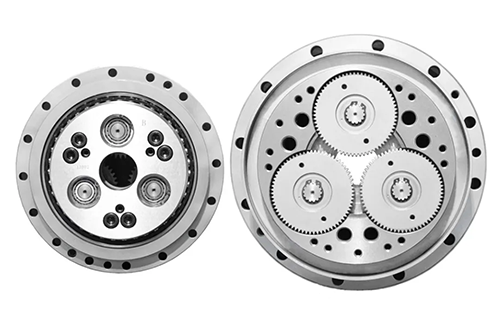
1、 Design principle of cycloidal pinwheel precision reducer
Cycloid pinwheel precision reducer is a transmission device that applies the principle of planetary transmission and achieves deceleration through cycloidal pinwheel meshing. Its core components include cycloid gear, needle pin, needle housing, and output mechanism.
In terms of design principle, the cycloidal pinwheel reducer adopts the K-H-V low tooth difference planetary transmission principle. A double eccentric sleeve with a 180 degree offset is installed on the input shaft, and two roller bearings are mounted on the eccentric sleeve to form an H mechanism. The center holes of the two cycloid gears are the raceways of the eccentric arm bearings. The cycloid gears mesh with a set of annular arranged needle teeth pins on the needle tooth housing, forming a low tooth difference internal meshing reduction mechanism. When the input shaft rotates once with an eccentric sleeve, due to the characteristics of the tooth profile curve on the cycloid gear and the limitation of the needle pin on the needle housing, the motion of the cycloid gear becomes a planar motion with both revolution and rotation. When the input shaft rotates one revolution in the forward direction, the eccentric sleeve also rotates one revolution, and the cycloidal gear rotates one tooth difference in the opposite direction, thereby achieving deceleration. The motion after deceleration is transmitted to the output shaft through the output mechanism, resulting in a lower output speed.
2、 Analysis of Transmission Efficiency of Cycloid Needle Wheel Precision Reducer
The transmission efficiency of cycloidal pinwheel precision reducer is one of the important indicators to measure its performance. High transmission efficiency means less energy loss and more energy-efficient equipment operation.
1. Compact structure with minimal friction loss
The cycloidal pinwheel reducer adopts a planetary transmission structure, which is compact in structure, small in size, and light in weight. Meanwhile, due to the rolling friction of all contact parts, the friction loss is greatly reduced compared to sliding friction. This makes the cycloidal pinwheel reducer have less energy loss and higher transmission efficiency during the transmission process.
2. Multiple teeth, smooth meshing
The cycloid gear and needle pin of the cycloidal pinwheel reducer have a relatively large number of teeth meshing simultaneously, theoretically up to half of the teeth meshing. The characteristic of multi tooth meshing makes the transmission smoother, reduces impact and vibration, and further improves transmission efficiency.
3. Excellent materials and advanced manufacturing processes
The main components such as cycloidal gears and pin teeth are made of GCr15 bearing steel with good material quality, which has a complex manufacturing process and high precision. This excellent material and advanced manufacturing process ensure good fit and precise meshing between parts, thereby improving transmission efficiency.
4. Wide transmission ratio range and strong adaptability
The transmission ratio range of the cycloidal pinwheel reducer is large, with a single-stage transmission ratio of 1:87 and a multi-stage transmission ratio even larger. This large transmission ratio range enables the cycloidal pinwheel reducer to adapt to the transmission requirements under different working conditions, improving the adaptability and flexibility of the equipment.
However, it should be noted that although the cycloidal pinwheel reducer has many advantages, its manufacturing process is complex and requires high precision of the parts. At the same time, as a weak link in the reducer, the arm bearing is subjected to high forces and has a slightly higher rotational speed than the high-speed shaft, which to some extent limits the rotational speed and transmitted power of the high-speed shaft.
In summary, the cycloidal pinwheel precision reducer plays an important role in industrial automation and precision manufacturing due to its unique design principles and excellent transmission performance. By optimizing structural design, improving manufacturing technology, and selecting high-quality materials, the transmission efficiency and service life of the cycloidal pinwheel reducer can be further improved. In the future, with the continuous advancement and innovation of technology, cycloidal pinwheel reducers are expected to be widely applied and promoted in more fields.
Harmonic Drive,gear motor,Precision reducer
Address: No.66 bis, Hetong Road, Dongfeng Town, Zhongshan City, Guangdong Province
Tel:0760-22189558
Mobile:13923325827

©2023 GUANGDONG YONGKUN MOTOR CO.,LTD All rights reserved


