
【 Science popularization of reduction motors 】 Characteristics of self-locking function of worm gear reducer
Release Time :
2024-09-27
Source :
network
Author:
YONGKUN MOTOR
What is self-locking function
The self-locking function of the worm gear reducer refers to the fact that under certain conditions, the worm gear transmission can only be driven by the worm wheel to rotate, and cannot be driven by the worm wheel to rotate.
When the helix angle of the worm gear is less than the equivalent friction angle of the meshing surface, the worm gear reducer has self-locking function.
What is the principle of self-locking of worm gear reducer
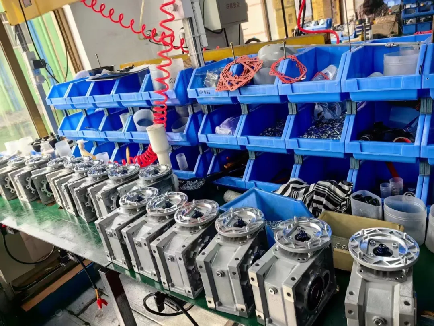
The self-locking of worm gear reducers requires certain conditions to be met. Applying reverse torque to a worm gear reducer will generate a reverse efficiency of η '=2-1/η, which is significantly lower than the forward efficiency of η. Generally, when the forward efficiency of η ≤ 0.5, the worm gear reducer will exhibit a self-locking state. Meanwhile, not only a small number of high speed ratio worm gear reducers have static self-locking, and the self-locking situation can be affected by various factors such as manufacturing accuracy and lubrication conditions.
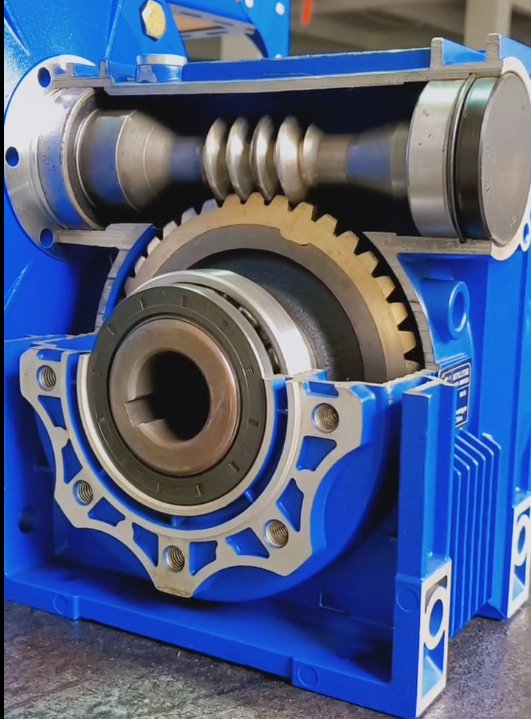
The self-locking principle of worm gear reducer is:
When the lead angle of the worm is less than the equivalent friction angle between the meshing teeth, the mechanism has self-locking properties and can achieve reverse self-locking, that is, only the worm can drive the worm wheel, not the worm wheel. The self-locking worm mechanism used in other machinery can provide safety protection through its reverse self-locking property.
Worm gear reducer,NMRV,motor
Address: No.66 bis, Hetong Road, Dongfeng Town, Zhongshan City, Guangdong Province
Tel:0760-22189558
Mobile:13923325827

©2023 GUANGDONG YONGKUN MOTOR CO.,LTD All rights reserved


