
A Brief Discussion on Stepper Motor Blockage Detection/Out of Step Detection/Zero Point Detection
Release Time :
2025-07-10
Source :
network
Author:
Yongkun Motor
A Brief Discussion on Stepper Motor Blockage Detection/Out of Step Detection/Zero Point Detection
The locked rotor detection/out of step detection/zero point detection of stepper motors are three very important detection functions in the design and application of stepper motors. Today, let's briefly understand their implementation methods.
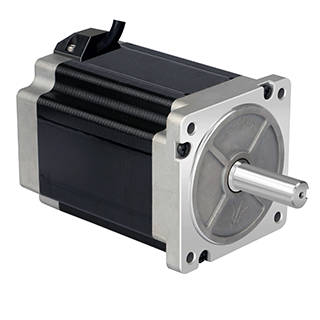
Blockage detection
When stalling occurs, the current applied by the stepper motor increases but the motor does not generate the corresponding torque, resulting in the inability to reach the target angle. The key to detecting stalling lies in monitoring abnormal changes in the motor's operating status.
Current monitoring method
Detection Principle
When stuck, the phase current of the motor coil usually increases significantly.
implement steps
Add a current sampling resistor to the drive circuit and amplify the sampling signal using an operational amplifier.
Use an analog-to-digital converter (ADC) to transmit the current signal to the microcontroller.
Set the current threshold value, and when the sampled current exceeds the set value, it is judged as locked rotor.
Design key points
High frequency noise interference: The switching frequency of the driving current of the stepper motor is relatively high, which may cause sampling errors.
Threshold value setting: The threshold value needs to be dynamically adjusted due to changes in load or different operating modes.
Power consumption and thermal design: Sampling resistors will bring additional power consumption, and it is necessary to balance measurement accuracy and thermal stability
Design difficulties
Real time sampling of phase current to ensure that the signal is fast enough (high sampling rate to meet the dynamic response requirements of the motor).
Set reasonable threshold values (to avoid false alarms of stalling during normal operation).
Circuit design requires a high signal-to-noise ratio to reduce the impact of external interference on current signals.
Application case: 3D printers usually use this method to detect motor stalling to avoid damage to the print head.
Vibration signal detection method
Detection Principle
Blocking transfers generates specific vibration frequencies and amplitudes.
implement steps
Use acceleration sensors to collect motor vibration data.
Apply Fast Fourier Transform (FFT) to analyze vibration spectra.
If a specific abnormal frequency appears in the spectrum, it is judged as stalling.
Design key points
Choose a suitable vibration sensor (such as an accelerometer) to ensure sensitivity covers the vibration range during stalling.
Signal processing requires the use of Fast Fourier Transform (FFT) or bandpass filtering to extract vibration frequency characteristics.
Optimization of matching between vibration threshold and stall characteristics.
Design difficulties
Sensor installation location: It must be fixed in a position with good vibration conductivity to avoid errors.
External vibration interference: Other mechanical vibrations may cause misjudgment and require reliable feature extraction.
Real time performance: The processing of vibration signals is complex and may affect real-time performance.
Application case: In the application of robotic arms, vibration detection can be combined to avoid structural damage caused by stalling.
Precision motor,gear motor,stepping motor
Address: No.66 bis, Hetong Road, Dongfeng Town, Zhongshan City, Guangdong Province
Tel:0760-22189558
Mobile:13923325827

©2023 GUANGDONG YONGKUN MOTOR CO.,LTD All rights reserved


