
Do single-phase motors require capacitors, while three-phase motors do not?
Release Time :
2025-07-16
Source :
network
Author:
Yongkun Motor
Do single-phase motors require capacitors, while three-phase motors do not?
Why do single-phase motors require capacitors, while three-phase motors do not? Before that, let's first understand the respective characteristics of single-phase motors and three-phase motors.
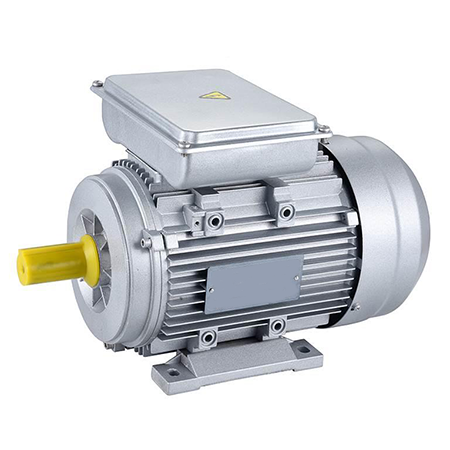
There are two coils in a single-phase motor, the main coil and the secondary coil. When a single-phase sine current passes through the main coil, the main coil generates an alternating pulsating magnetic field. The strength of this magnetic field varies with time as a sine current, but its direction remains 1-3.
If there is no force provided by other coils, the motor will not rotate after turning 90 degrees. If you want it to rotate, you also need to apply a force perpendicular to the direction of the main coil, provided by the starting coil, which is the secondary coil.
In order for the secondary coil to provide a force perpendicular to the direction of the main coil, another phase current must be applied to the secondary coil. If the same phase current is applied, then the direction of the force they generate is also the same. But what if there is only single-phase electricity?
At this point, we need to use capacitor phase shifting. Simply put, it is to connect capacitors in series in the circuit that requires phase shifting, so as to change the phase of the current. After the phase shift of single-phase AC power, its waveform will become as shown in the following figure.
Finally, when combined, the motor wiring diagram is as shown in the following figure. Firstly, a sinusoidal alternating current enters from point A, with a portion supplying power to the main coil and the other portion shifting phase through a capacitor. Due to the phase shift of the two-phase electricity, the magnetic field force generated by the coil will also shift back and forth. In this way, the main coil can be pushed, then the secondary coil can be pushed, and finally rotated.
If you want the motor to reverse, simply replace the power cord connected to point A in the diagram with point B, and do not move the power cord connected to point C.
Because before the replacement, the main coil used a zero phase sine AC power, and the secondary coil used a phase shifted sine AC power. After the power cord is switched to point B, the secondary coil uses zero phase sine AC power, while the main coil uses phase shifted sine AC power. If the current phase of two coils changes, the direction of the magnetic field force they generate will also change, and the rotation will also change.
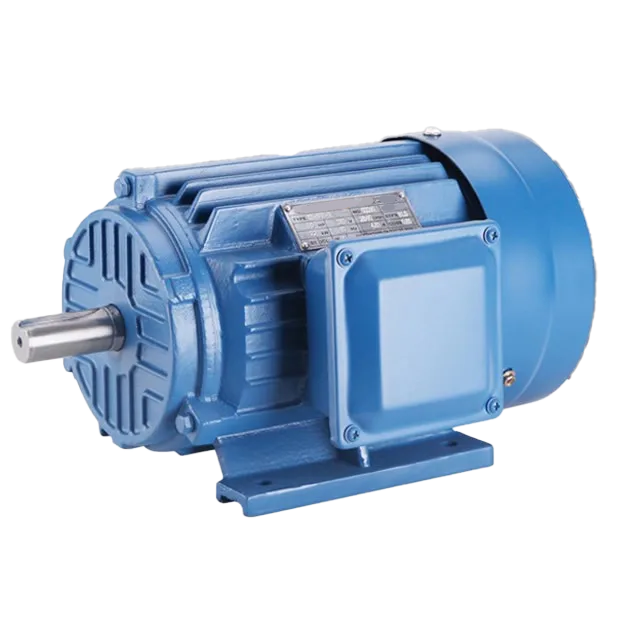
The motor uses a three-phase AC power supply, and due to the phase difference of 120 ° between the three-phase AC power supply and the motor. When three-phase AC power is applied to the stator winding, a rotating magnetic field is generated inside the stator. When a rotating magnetic field cuts the rotor winding, the rotor winding will generate induced current, which will be subjected to electromagnetic force in the rotating magnetic field, causing it to rotate.
The three-phase motor uses a three-phase power supply, with a phase difference of 120 degrees. We can simply understand a three-phase motor as three people standing at three different angles pushing the rotor. A single-phase motor uses a single-phase power supply and capacitor, with a phase difference of 90 degrees between the main and auxiliary coils. We can simply understand a single-phase motor as two people standing at two different angles pushing the rotor.
So, a three-phase motor with the same power has a greater torque (rotational force) than a single-phase motor.
Therefore, if there is a three-phase power supply, three-phase motors should be used as much as possible, because three-phase motors with the same power have the advantages of smaller size, lighter weight, lower noise, lower price, and higher torque compared to single-phase motors.
Single phase motor,Reducer,electrical machinery
Address: No.66 bis, Hetong Road, Dongfeng Town, Zhongshan City, Guangdong Province
Tel:0760-22189558
Mobile:13923325827

©2023 GUANGDONG YONGKUN MOTOR CO.,LTD All rights reserved


