Harmonic reducer and its application
Release Time :
2025-07-17
Source :
network
Author:
Yongkun Motor
Harmonic reducer and its application
Harmonic reducer is a transmission device that uses a wave generator to generate controllable elastic deformation waves on flexible wheels, and through its interaction with rigid wheels, achieves motion and power transmission. Its structure mainly consists of three basic components: a rigid gear (rigid wheel) with an internal ring gear, a flexible gear (flexible wheel) with an external ring gear, and a wave generator.
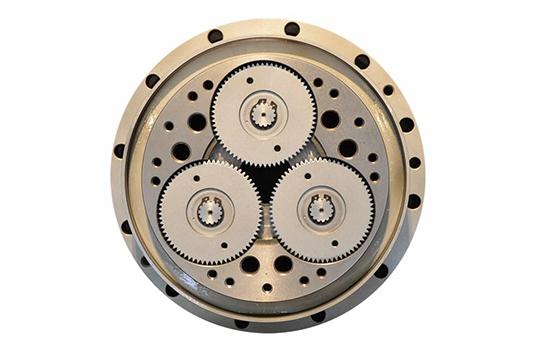
The working principle of harmonic reducer usually adopts the form of active wave generator, fixed rigid wheel, and flexible wheel output. When the wave generator is installed in the inner circle of the flexible wheel, it forces the flexible wheel to undergo elastic deformation and become elliptical, so that the flexible wheel gear at its long axis is inserted into the gear groove of the rigid wheel, becoming a fully engaged state; At the short axis, the two wheel teeth are completely out of contact and in a disengaged state. When the wave generator continues to rotate, it forces the flexible wheel to continuously deform and produce misaligned motion, thereby achieving motion transmission between the wave generator and the flexible wheel.
1、 Advantages and disadvantages of harmonic reducers:
1. Harmonic reducers have the advantages of high transmission accuracy, high transmission ratio, and small volume and mass.
(1) High transmission accuracy: Due to the large number of teeth meshing simultaneously in harmonic transmission, the error is averaged, that is, the multi tooth meshing has a mutual compensation effect on the error, resulting in high transmission accuracy. When the gear accuracy level is the same, the transmission error is only about 1/4 of that of ordinary cylindrical gear transmission. At the same time, a slight change in the radius of the wave generator can be used to increase the deformation of the flexible wheel, making the backlash very small, and even achieving backlash free meshing. Therefore, the transmission clearance is small and suitable for reverse rotation.
(2) Higher transmission ratio: For every 180 degrees rotation of the wave generator, due to the partial contact between the flexible and rigid wheels, only one tooth position of the rigid wheel will change, resulting in a deceleration effect, thus also having a higher transmission ratio.
(3) Small volume mass: Due to its special flexible wheel transmission structure, the harmonic reducer has fewer core components. With the same output torque, the volume can be reduced by 2/3 and the weight can be reduced by 1/2.
2. The disadvantage lies in its relatively low transmission efficiency, low torque, and short lifespan.
(1) Lower transmission efficiency: Harmonic reducers experience certain energy losses during the transmission process due to factors such as elastic deformation and meshing friction of the flexible wheels, resulting in relatively lower transmission efficiency.
(2) Low torque: Harmonic reducers may face problems such as excessive deformation or poor meshing of the flexible wheels when subjected to high torque, so the output torque is generally low.
(3) Short lifespan: The working principle of harmonic reducers relies on the elastic deformation of flexible wheels, which can lead to material fatigue and wear over long-term use. Flexible wheels require repeated high-speed deformation, making them relatively fragile and prone to cracking or fracture in stress concentration areas.
2、 The technical barriers of harmonic reducers mainly lie in flexible wheel technology and the selection of rigid wheel materials.
1. Soft wheel technology
(1) Material selection: For example, 40Cr material is commonly used in flexible wheel materials both domestically and internationally. However, unreasonable grain and ferrite phases can lead to local microcracks and changes in dimensional accuracy. Therefore, it is necessary to choose materials with high purity of the original billet and low levels of impurities and non-metallic inclusions.
(2) Tooth profile design and processing: Different tooth profile designs can have an impact on transmission performance, such as the large transmission error of involute tooth profiles; The circular tooth profile has good working performance and low friction; The cycloidal profile inherits the advantages of the circular arc profile, but the design of cycloidal gear teeth is complex and difficult, and manufacturing and assembly errors can seriously affect the accuracy of harmonic transmission.
2. Material selection for rigid wheels
The rigid wheel needs to constantly come into contact with the flexible wheel during the transmission process, and is transmitted through friction. Therefore, the wear resistance of the rigid wheel directly affects the service life of the reducer. For example, under similar hardness conditions in 2Cr13 stainless steel, 40Cr medium carbon alloy steel, and 45 steel, 40Cr exhibits better wear resistance than 2Cr13. The hardness value of 45 steel differs the most from that of the friction pair material, and its wear resistance is the worst.
Harmonic reducers are widely used and currently occupy a major share in the field of industrial robots. They are also widely used in intelligent logistics, new energy, high-end CNC machine tools, medical equipment, semiconductor production equipment, and other fields. Due to the need for humanoid robots to simulate flexible human movements, harmonic reducers are widely used in the joints of robots, such as elbows and wrists, and will be an important application scenario in the future.
electrical machinery,Harmonic deceleration stage,Precision reducer
Address: No.66 bis, Hetong Road, Dongfeng Town, Zhongshan City, Guangdong Province
Tel:0760-22189558
Mobile:13923325827

©2023 GUANGDONG YONGKUN MOTOR CO.,LTD All rights reserved


