
The problem of broken shafts caused by different concentricity
Release Time :
2024-09-29
Source :
network
Author:
YONGKUN MOTOR
Some users experience a break in the output shaft of the drive motor after the device has been running for a period of time. Why does the output shaft of the driving motor twist and break? When we carefully examine the cross-section of the output shaft where the drive motor is broken, we will find that the outer edge of the cross-section is brighter, while the color of the cross-section becomes darker towards the axis. Finally, there are broken marks (dot marks) at the axis. This phenomenon is mostly caused by the lack of concentricity between the drive motor and the reducer during assembly.
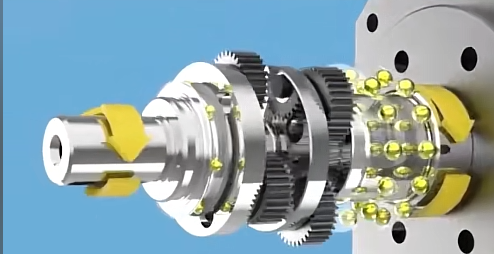
When the concentricity between the drive motor and the reducer is well ensured, the output shaft of the drive motor only bears rotational force (torque), and the operation will be smooth without pulsation. When not concentric, the output shaft of the driving motor also has to bear the radial force (bending moment) from the input end of the reducer. The effect of this radial force will force the output shaft of the drive motor to bend, and the direction of bending will continuously change as the output shaft rotates. If the concentricity error is large, the radial force will cause the local temperature of the motor output shaft to rise, and its microstructure will be continuously damaged, ultimately leading to the fracture of the drive motor output shaft due to local fatigue. The larger the error in concentricity between the two, the shorter the time it takes for the output shaft of the driving motor to break. At the same time as the output shaft of the drive motor breaks, the input end of the reducer will also bear radial forces from the output shaft of the drive motor. If this radial force exceeds the greater radial load that the input end of the reducer can bear, the result will also cause deformation or even fracture of the input end of the reducer or damage to the supporting bearings at the input end. Therefore, ensuring concentricity during assembly is crucial!
From the perspective of assembly technology, if the drive motor shaft and the input end of the reducer are concentric, the contact surface between the drive motor shaft and the input end hole of the reducer will be very close, with no radial force or deformation space. If the assembly is not concentric, there will be a mismatch or gap between the contact surfaces, resulting in radial force and providing space for deformation.
Similarly, the output shaft of the gearbox also experiences breakage or bending, which is caused by the same reasons as the shaft breakage of the drive motor. But the output of the reducer is the product of the output of the driving motor and the reduction ratio, and the output is larger compared to the motor, so the output shaft of the reducer is more prone to breakage. Therefore, when using the reducer, users should pay more attention to ensuring the concentricity of its output end assembly!
Gear motor,electric machinery,motor
Address: No.66 bis, Hetong Road, Dongfeng Town, Zhongshan City, Guangdong Province
Tel:0760-22189558
Mobile:13923325827

©2023 GUANGDONG YONGKUN MOTOR CO.,LTD All rights reserved


