
6 methods for converting a three-phase motor to a single-phase motor
Release Time :
2024-09-05
Source :
network
Author:
YONGKUN MOTOR
Converting a three-phase motor to a single-phase motor is a relatively complex process, as a three-phase motor requires three independent power phases to operate properly, while a single-phase power supply only has one phase. However, for certain specific situations or low-power motors, this conversion can be achieved through some methods. Here are six methods to convert a three-phase motor to a single-phase motor:
Capacitance method
To change a three-phase asynchronous motor to single-phase operation, it is usually necessary to parallel one or two capacitors (operating capacitor and starting capacitor) on the motor.
The capacity of a capacitor needs to be calculated based on the rated current, rated voltage, and power factor of the motor.
For three-phase asynchronous motors with a power below 1KW, only one operating capacitor can be used, and the capacity can be estimated as C1=13I (C1 unit is uF, I is the rated current of the original motor, A).
For higher power motors, both operating capacitors and starting capacitors need to be configured simultaneously. The capacity of the starting capacitor is generally 1-4 times that of the operating capacitor.
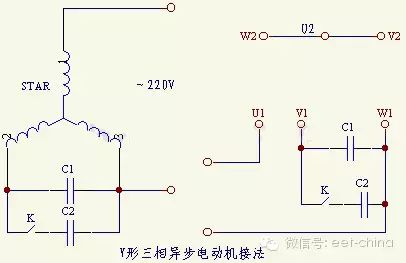
matters needing attention:
The withstand voltage value of the capacitor must not be lower than 450V.
The capacity of the capacitor should be selected appropriately, otherwise the motor cannot operate normally and the temperature rise is too high.
The three-phase asynchronous motor with Y-shaped connection should be reconnected as shown in the following figure:
The three-phase asynchronous motor with delta connection method should be reconnected as shown in the following figure:
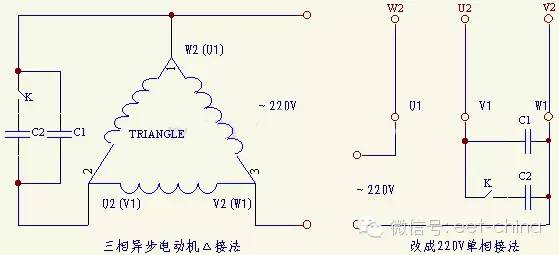
At this time, the output power of the motor is 55% to 90% of the nominal power. In the figure, C1 is the operating capacitor and C2 is the starting capacitor, both of which require the use of power capacitors with a withstand voltage value of not less than 450V. The capacity of C1 and C2 can be estimated using the following formula:
C1=1950I/U×cosθ
C2=(1~4)C1
The unit of C in the formula is (uF); I is the rated current of the motor (A); U is the rated voltage of the motor (V); Cos θ is the power factor, generally ranging from 0.5 to 0.7.
Specifically, for three-phase asynchronous motors with a power of less than 1KW, C2 can be omitted, but the value of C1 should be appropriately increased. It can be estimated and selected as C1=13I, where C1 is in units of (uF) and I is the rated current of the original motor (A).
For low-power three-phase asynchronous motors with only a few hundred watts, the capacitance can be selected as C=0.06P (when Y is connected) and C=0.1P (when △ is connected), where C is in (uF) and P is the motor power (W). The capacity of C1 and C2 can be the same. If the speed is too fast, the load can be increased or the capacitance can be reduced. If the speed is too slow, the load can be reduced or the capacitance can be increased.
Improved capacitance method
In order to increase the output power of the motor, additional capacitors and resistors can be added on the basis of the traditional capacitive method.
The specific wiring method and the selection of capacitance and resistance capacity need to be determined based on the specific parameters of the motor.
You can refer to the wiring method shown in the following figure. The selection of C1 is the same as that of C1, C2, C3, and R in "Method 1", and they are selected according to the following formula:
C2=(2~4)C1
C3=2C1
R=0.25U/I
Capacitive and Inductive Phase Shifting Method
Using an inductor (paying attention to the current carrying capacity of inductor L) and a capacitor to obtain three-phase symmetrical voltage from a single-phase power supply, and wiring according to the following diagram, this method has strong adaptability, but requires the configuration of an iron core inductor, which can also be replaced by a single-phase autotransformer. This method is suitable for larger electric motors. For example, when the motor is 2.2KW and "△ connection" is used, the capacitor C is selected as 254uF and the inductor L is selected as 78mH. Capacitor C and inductor L can be selected according to the following formula:
C=(Ssin(60+φ)×10^6)/(1.5WU^2)
L=(1.5U^2)/(WSsin(60-φ))
The working capacitance of C in the formula is (uF); L: Inductance (H); S: Rated power of electric motor (VA); φ: Power factor angle (degrees) at rated load of the electric motor; W: Angular frequency (W=2 π F=314)
04 Distribution Resistance Method
By connecting resistors in series or parallel in the motor circuit, the impedance characteristics of the motor can be changed to adapt to single-phase power supply. The specific implementation of this method needs to be determined based on the specific parameters of the motor and the expected operating effect.
The selection of resistor R in the following figure should be appropriate. The R value can be selected as 5-10 times the resistance value of the two-phase winding, and QA in the figure is the button switch.
Add customs clearance method
By adding switching elements (such as relays, contactors, etc.) in the motor circuit, the motor can switch between different states.
Install the start switch K as shown in the diagram to enable single-phase operation.
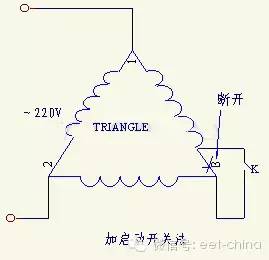
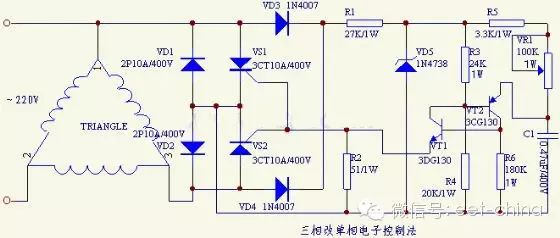
Electronic Control Law
For three-phase asynchronous motors with a power of 2-3KW, the capacity of the phase-shifting capacitor needs to reach 200-300 uF or more. Due to its high voltage resistance, it is bulky and expensive. However, using this rule does not require phase-shifting capacitors. It has been proven that when the motor adopts the "△ connection", the speed does not exceed 1500 revolutions per minute, and the starting device can effectively cooperate with it.
Note: For three-phase asynchronous motors, the rated current per kW is generally about 2A, which means the rated current of a 2.2kW three-phase asynchronous motor is about 4.4A.
Summary
There are various methods to convert a three-phase motor into a single-phase motor, but each method has its own scope of application and limitations. When choosing a specific method, it is necessary to comprehensively consider factors such as the specific parameters of the motor, the expected operating effect, and cost. Meanwhile, due to the technical risks involved in motor modification, if unfamiliar with the relevant technology, it is recommended to consult professionals or purchase specialized single-phase motors to ensure the safe and stable operation of the motor.
electrical machinery,motor
Address: No.66 bis, Hetong Road, Dongfeng Town, Zhongshan City, Guangdong Province
Tel:0760-22189558
Mobile:13923325827

©2023 GUANGDONG YONGKUN MOTOR CO.,LTD All rights reserved


