
The difference between permanent magnet synchronous servo motor and asynchronous servo motor
Release Time :
2024-10-08
Source :
network
Author:
YONGKUN MOTOR
Servo motors can control speed and position accuracy very accurately, and can convert voltage signals into torque and speed to drive control objects. The rotor speed of a servo motor is controlled by input signals and can react quickly. In automatic control systems, it is used as an actuator and has characteristics such as small electromechanical time constant, high linearity, and starting voltage. It can convert the received electrical signal into angular displacement or angular velocity output on the motor shaft. Servo motors are mainly divided into DC servo motors and AC servo motors, among which DC servo is further divided into brushed DC servo and brushless DC servo, and AC servo is further divided into asynchronous AC servo and permanent magnet synchronous AC servo. (Actually, brushless DC servo can also be considered as a type of AC servo, but the difference is that it uses DC power supply and controls electronic commutation to achieve AC motor drive)
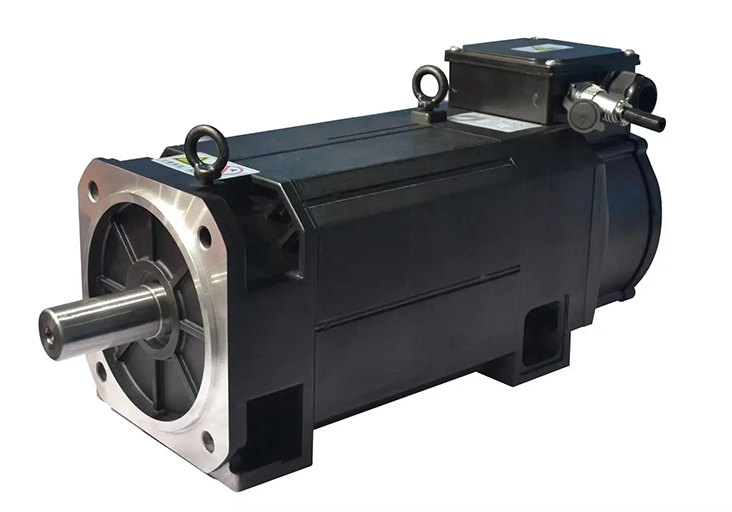
However, as it is mainly used for control, most servo motors on the market usually refer to permanent magnet synchronous motors because of their optimal control response performance; Over time, the servo motors commonly referred to in daily life are usually permanent magnet synchronous motors. The rotor inside the permanent magnet synchronous servo motor is a permanent magnet. The U/V/W three-phase electricity controlled by the driver forms an electromagnetic field, and the rotor rotates under the action of this magnetic field. At the same time, the encoder provided by the motor feeds back the signal to the driver, and the driver compares the feedback value with the target value to adjust the angle of rotation of the rotor.
Synchronous motors and asynchronous motors have different speeds, motor structures and principles, and different uses. Asynchronous motors use alternating current to generate a magnetic field, while synchronous motors artificially add direct current to the rotor to form a constant magnetic field. In this way, the rotor rotates synchronously with the rotating magnetic field of the stator, and their structures and principles are different. Synchronous motors are mostly used in large generator applications, while asynchronous motors are almost exclusively used in electric motor applications.
The main difference between permanent magnet synchronous motors and asynchronous motors is the excitation current inside the rotor. The excitation current of the rotor of a synchronous motor comes from an external DC power source, and the constant speed is only related to the number of pole pairs of the motor stator winding, and does not vary with the size of the load. The speed of asynchronous motors is always lower than the synchronous speed of the motor during operation. The higher the load, the lower the motor speed, and the greater the current generated by the rotor cutting the stator magnetic induction line.
The power factor of synchronous motors can be adjusted by changing the rotor current, that is, synchronous motors can absorb reactive power from the power system and generate reactive power, while asynchronous motors cannot be adjusted. The rotor needs to generate self induced current before it can rotate, and the current always lags behind the voltage. So synchronous motors do not require reactive power compensation, while asynchronous motors require reactive power compensation.
The stability and working efficiency of synchronous motors are higher than those of asynchronous motors.
But compared to asynchronous motors, synchronous motors have a more complex structure and require carbon brushes. The function of carbon brushes is to introduce DC into the rotor coil through slip rings, and the rotor generates torque under the action of the rotating magnetic field. So generally, synchronous motors are used in high-power, low-speed working environments. Of course, there is also synchronous phase-shifting in the regulation of the power system, mainly aimed at compensating for reactive power in the grid.
Gear motor,servo motor ,electric machinery
Address: No.66 bis, Hetong Road, Dongfeng Town, Zhongshan City, Guangdong Province
Tel:0760-22189558
Mobile:13923325827

©2023 GUANGDONG YONGKUN MOTOR CO.,LTD All rights reserved


