
Basic knowledge of motor windings: pole spacing, pitch, winding coefficient
Release Time :
2024-10-10
Source :
network
Author:
YONGKUN MOTOR
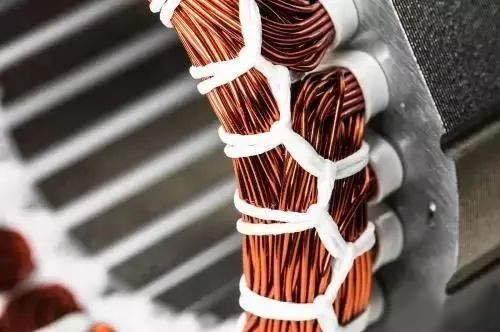
Basic parameters of motor winding
1. Mechanical angle and electrical angle
When the motor winding is distributed in the iron core slot, it must be embedded and connected according to certain rules in order to output symmetrical sinusoidal AC power or generate a rotating magnetic field. In addition to being related to other parameters, when reflecting the laws of relative positions between coils and windings, we also need to use the concept of electrical efficiency. From mechanics, it is known that a circle can be divided into 360 degrees, which is commonly referred to as the mechanical angle. In electrical engineering, the angle unit used to measure electromagnetic relationships is called electrical angle. It divides each cycle of a sinusoidal alternating current into 360 degrees on the horizontal axis, which means that when a conductor passes through a pair of magnetic poles, the electromagnetic angle changes by 360 degrees. Therefore, the relationship between electrical angle and mechanical angle in a motor is: electrical angle α=pole pairs xPx360 °. For example, for a two pole motor, the number of pole pairs p=1, and the electrical angle is equal to the mechanical angle. For a four pole motor, p=2, and the motor has two pairs of magnetic poles on one circumference, corresponding to an electrical angle of 2 × 360 °=720 °. and so on.
2. Polar distance (τ)
The pole spacing of a winding refers to the distance between each magnetic pole and the circumferential surface of the iron core. Generally refers to the slot spacing between the centers of adjacent magnetic poles of the motor iron core, and the slot spacing calculation of the inner circular air gap surface of the stator iron core; The rotor is calculated based on the slot spacing of the air gap surface on the outer circumference of the iron core. There are usually two ways to represent polar distance, one is by length; Another way is to express it in terms of the number of slots, which is usually more commonly used. Generally, the pole spacing is expressed as τ=Z1/2p.
3. Pitch (y)
The number of iron core slots occupied between the two component sides of each coil in the motor winding is called pitch, also known as span. When the pitch of the coil element is symmetrical to the pole distance, it is called a full distance winding, y=τ; when the pitch of the coil element is less than the pole distance, it is called a short distance winding, y < τ; and when the pitch of the coil element is greater than the pole distance, it is called a long distance winding y > τ. Due to the many advantages of using shorter electromagnetic wires at the end and higher power factor, short distance windings are commonly used in double-layer stacked windings.
4. Winding coefficient
The winding coefficient refers to the product of the short distance coefficient and the distribution coefficient of the AC distributed winding, that is
Kdp1=Kd1Kp1。
5. Pitch angle (α)
The electrical angle between two adjacent slots of the motor iron core is called the slot pitch angle, usually represented by a, that is
α=total electrical angle/z1=p × 360 °/z1
6. Xiangbelt
Phase band refers to the area occupied by each phase winding at each magnetic pole, usually expressed in electrical angles or slot numbers. If the winding of a three-phase motor under each pair of magnetic poles is divided into six regions, then there are three regions under each pole. Due to the slot pitch angle α=360 ° P/Z, if the motor is a 4-pole 24 slot motor, the width of each phase and region is q α=Z/6P * 360P/Z=60 °. The winding wound in this distribution is called a 60 ° phase belt winding. Due to the obvious advantages of 60 ° continuous phase winding, this winding is widely used in three-phase motors.
7. Number of slots per pole and per phase (q)
The number of slots per pole and per phase refers to the number of slots occupied by each phase winding in each magnetic pole, and the number of coils to be wound in each pole and per phase winding is determined based on it. That is
q=Z/2Pm
Z: Number of iron core slots; 2P: Number of motor poles; Number of motor phases.
The calculation result, if q is an integer, is called an integer slot winding; If q is a fraction, it is called a fractional slot winding.
8. Number of conductors per slot
The number of conductors per slot of the motor winding should be an integer, and the number of conductors per slot of the double-layer winding should also be an even integer. The number of conductors per slot of the wound rotor winding is determined by its open circuit voltage, and the number of conductors per slot of the wound rotor for medium-sized motors must be equal to 2. The number of conductors per slot of the stator winding can be calculated by the following formula:
NS1=NΦ1m1a1/Z1
NS1: number of conductors per slot of stator winding;
N Φ 1: The number of conductors per slot calculated based on the air gap magnetic density;
M1: number of stator winding phases;
A1: Number of parallel branches of stator winding;
Z1: Number of stator slots.
9. Number of series conductors per phase
The number of series conductors per phase refers to the number of turns of the bus connected in series with each phase winding in the motor. However, the number of turns in the series bus is related to the number of parallel branches in each phase winding. For example, if the number of parallel branches in a motor is a 1-way connection, then the number of turns in all series lines of the lower coils of each pole of the motor should be added together to form the total number of turns in the phase winding bus. If there are multiple parallel branches in each phase winding of the motor, such as 2-channel connection or 3-channel connection, the number of series conductors in each phase can only be based on the number of turns of one winding connected in series. Because the number of series turns in each branch of the phase winding is the same, it is impossible to increase the number of series turns when connected in parallel to form a phase winding.
10. Number of bus cycles
The winding inside the motor is composed of coils of various sizes and shapes. Due to the fact that each coil has two component edges embedded in the iron core slot, it means that each coil needs to be embedded in two slots. In a single-layer winding, only one coil element edge is embedded in each slot, so the number of bus coils is only equal to half of the total number of slots; In a double-layer winding, two coil elements are embedded in the upper and lower layers of each slot, so the total number of coils is equal to the number of iron core slots.
Gear motor,Gearbox,electric machinery
Address: No.66 bis, Hetong Road, Dongfeng Town, Zhongshan City, Guangdong Province
Tel:0760-22189558
Mobile:13923325827

©2023 GUANGDONG YONGKUN MOTOR CO.,LTD All rights reserved


