
Acceptance criteria for gearbox
Release Time :
2024-10-17
Source :
network
Author:
Made by Guangdong Yongkun Motor Co., Ltd
Regarding the acceptance inspection items and installation precautions for the gearbox, as well as daily maintenance items. Specifically, as follows:
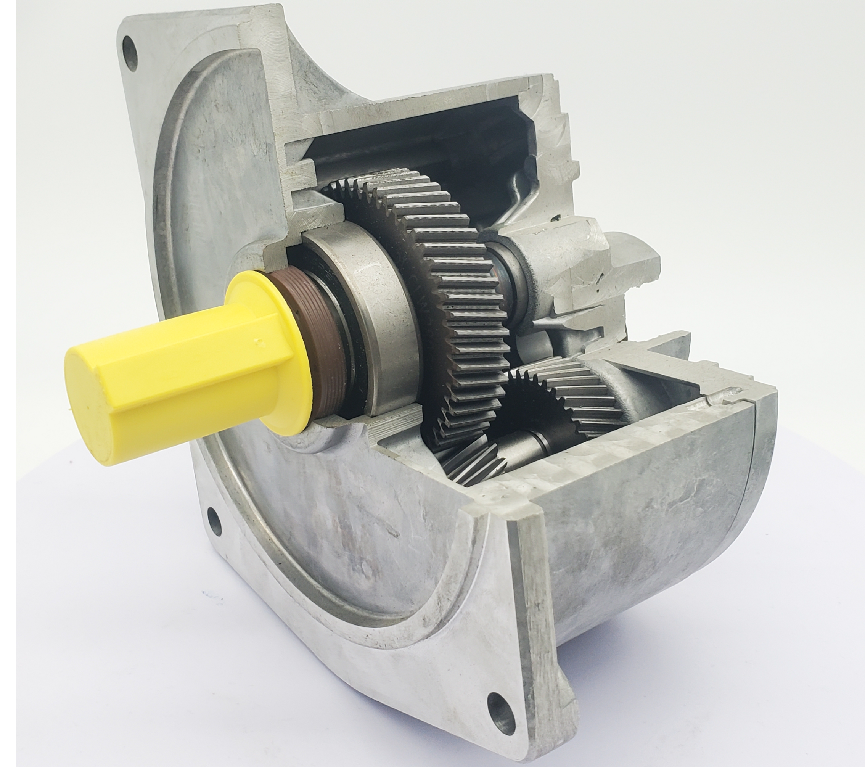
1、 Appearance inspection; 2、 No load, temperature rise test; 3、 Bearing clearance test; 4、 Measurement test of box vibration; 5、 Measurement test of shaft vibration displacement; 6、 Requirements for Installation and Adjustment 7. Daily Inspection and Maintenance of Gearbox
1、 Appearance inspection
1. Through visual inspection, the appearance should be glossy, the spray paint should be evenly closed, and the end caps, upper and lower caps, and other screws should be complete; Is there a nameplate and is the nameplate content clear and correct.
2. No gaskets are allowed to be filled between the dividing surfaces of the box, but sealant or water glass can be applied to ensure sealing;
During assembly, before tightening the bolts of the box body, a 0.05mm feeler gauge should be used to check the sealing between the joint surface of the box cover and the box seat;
4. Lubricating grease should be applied to the shaft extension seal. The sealing devices of the reducer should be installed strictly according to the requirements.
2、 No load, temperature rise test
Add sufficient clean lubricating oil according to the prescribed amount, and conduct forward and reverse no-load test runs at the rated speed. The trial operation time should be at least half an hour and meet the following requirements:
1. No loose connections or fasteners are allowed. 2. There shall be no oil leakage or seepage at any sealing or joint. 3. The operation of the reducer should be balanced and normal, without any impact, vibration, or abnormal noise. 4. The oil pump is working normally and the oil circuit is unobstructed.
After passing the no-load test run of the reducer, it should be subjected to a load test run. The load during the test should be slowly loaded in four stages at the rated speed, at 25%, 50%, 75%, and 100% of the rated load of the reducer. The running time of each stage is based on the stable temperature rise of the lubricating oil, and after continuous operation for 3 hours, the oil temperature should not exceed 100 ℃. If the gearbox itself has a cooling system, the oil temperature should not exceed 90 ℃.
3、 Bearing clearance test
When adjusting the clearance of the differential bearing, the axial momentum of the differential can be measured using a gauge, and the clearance allowance can refer to the departmental or national standards issued by the Ministry of Transport in recent years. If there are no detection conditions or reference data, the following method can be used to adjust the bearing clearance: first tighten the differential bearing adjustment nut in the opposite direction until the differential bearing cannot rotate, or add sufficient washers at the bottom of the thrust surface of the semi floating rear axle housing differential bearing to prevent the differential from rotating. And then. Gradually remove the gasket or loosen the nut with a thickness of 0.05-0.08mm, so that the differential can rotate freely in its position, and it is better to turn it 1-2 times by hand. However, it must be noted that the bearing clearance after the differential bearing cover or semi floating rear axle housing is fastened should be used as the standard. If the bearing clearance is adjusted by adjusting the nut, there will be a change in the bearing clearance after tightening the differential bearing cover, and the bearing cannot rotate. This is because the bearing sleeve is under pressure from the bearing cover. At this time, the main reason for the wear of the differential bearing when using shims is due to improper adjustment of the bearing clearance, in addition to severe lack of lubricating oil, deformation of the differential housing, and misalignment of the bearing neck. When the clearance adjustment of the bearing is too large, the bearing clearance will increase, leading to accelerated wear of the transmission connecting parts. When the clearance adjustment of the bearing is too small, the friction resistance of the bearing will be high. The bearing seat cushion should be sufficient for the bearing cover, that is, after the bearing cover bolts are tightened, the bearing outer sleeve cannot shrink or deform, and at the same time, the bearing outer sleeve cannot move inside the bearing cover. During transmission, high temperatures are generated, and under poor lubrication and heat dissipation conditions, bearings can be eroded. However, if lubrication and heat dissipation are still acceptable, the surface of the rolling rod can also be damaged (commonly known as bearing wear and tear). In short, adjusting the differential bearing clearance during warranty is the key to extending the service life of the bearings, so caution should be taken when adjusting the bearing clearance and timely maintenance should be carried out.
4、 Measurement test of box vibration
Measuring the vibration at the bearing seat can obtain the vibration intensity value at the measuring point. Since the measured vibration value is an absolute quantity, it is best to consider the supporting structure of the test as a fixed foundation structure. During the experiment, resonance of the supporting structure must be avoided at least within the speed range of the experiment. The measured vibration intensity is a function of the dynamic coupling between the rotating part of the gear device and the supporting box. The coupling is very direct when using rolling bearings, while when using sliding bearings, the vibration of the shaft is more or less suppressed due to the damping effect of the oil film. The sliding shaft is greatly affected by speed, torque, load, and lubricating oil. When evaluating the vibration intensity of the bearing seat, the influence of these changing factors must be considered. (Usually caused by imbalance and eccentricity) may not be strongly transmitted to the bearing seat of the gear device, but under heavy load conditions, the intensity of these vibration transmissions may be high. In addition, high-frequency vibrations caused by gear meshing are strongly transmitted to the bearing seat and dominate the measured vibration signals of the housing.
When measuring the vibration of the box, a speed sensor or accelerometer can be used. The linear range measured by the speed sensor depends on its type, generally ranging from 10-2500Hz. When it is lower than the meshing frequency of the high-speed gear device, an accelerometer with a measurement range of not less than 10kHz should be used. The instrument needs to be adjusted during use, and special attention should be paid to eliminating the influence of low-frequency noise when converting the signal into a speed signal. At the same time, the installation method of the sensor used must ensure the linear measurement range of the instrument.
5、 Measurement test of shaft vibration displacement
It is recommended to use non-contact sensors to measure the displacement of the shaft.
There are various forms of non-contact vibration sensors, and their measurement working principles are different. The main forms include capacitive, inductive, and eddy current sensors. Due to its wide frequency range, small size, and insensitivity to changes in working environment conditions, eddy current sensors are widely used in the measurement of gear devices.
Non contact sensors are generally used to measure the relative motion between gear shafts and bearing seats. Place two probes perpendicular to each other on the designated measurement surface, and the motion trajectory of the gear shaft can be displayed through an oscilloscope. Most flying contact sensors (mainly referring to eddy current sensors) can be used to determine the position of the shaft in the bearing clearance.
Although eddy current sensors have a wide frequency response range (0-10kHz), they can generally only detect a small amount of shaft vibration signals when the frequency exceeds 500Hz. Therefore, non-contact sensors are not suitable for vibration evaluation above 500Hz.
Non contact sensors can be used to identify vibration factors related to shaft imbalance and mechanical errors in the low-frequency range, such as gear radial runout, roundness, etc. It can also distinguish the magnitude of additional loads caused by gear forces, torque, and misalignment forces on the shaft, identify bearing related issues and possible instability.
When installing non-contact sensors, it is necessary to ensure that there is no significant relative motion between the sensor and the bearing or housing. It is best to use a rigid component to insert the sensor into the housing, and the sensor can be contacted from the outside without opening the housing cover for calibration and maintenance.
The measurement surface should be concentric with the shaft neck and comply with the evaluation level requirements (see 5.1 Vibration Measurement of Shaft).
Requirements for installation and adjustment
1. Installation of rolling bearings. When installing rolling bearings, the inner ring of the bearing should be tightly attached to the shaft shoulder, and the gap should not pass through a 0.05mm thick feeler gauge.
2. Axial clearance of bearings. For bearings with non adjustable clearance (such as deep groove ball bearings), the axial clearance is 0.25-0.4mm; The axial clearance value of the bearing with adjustable clearance. Click to view the axial clearance of tapered roller bearings; Axial clearance of angular contact ball bearings.
3. The backlash between the meshing teeth of gears (worm gears). You can use a feeler gauge or lead pressure method. Place the lead wire on the tooth groove, then rotate the gear to flatten the lead wire, and measure the sum of the thickness of the flattened lead wire on both tooth sides to obtain the size of the tooth side.
4. Tooth contact spots on cylindrical gears 2-10-4; Conical gear tooth surface contact spot 2-11-4; Worm gear transmission contact spot 2-12-4.
Daily inspection and maintenance of gearbox
Check the oil level, oil temperature, and oil pressure every day to ensure they are normal. Check for oil leaks at the output, input, and piping joints of the gearbox, check for normal temperatures at the bearings, and listen for normal operating sounds. Any abnormal phenomena should be immediately eliminated.
1. Daily inspection content:
Is the oil temperature (temperature rise) of the reducer normal.
Observe whether the oil pump and cooler are turned on, whether the lubricating oil circuit is unobstructed, and whether the current and pressure of the roller press are normal.
Check if the sound of the gearbox is normal and if there is any abnormal noise.
2. Weekly inspection content:
Clean the filter screen, magnetic rod, and inner cavity of the filter housing with kerosene or gasoline and wipe them clean. The foreign objects cleaned by the filter need to settle, be stored, and analyzed. When copper shavings appear, they need to be cleaned regularly every two days and the changes in copper shavings should be observed. If they do not decrease, the machine should be stopped immediately and the box should be opened for inspection. This is a precursor to abnormal wear of the bearing cage.
After cleaning the gearbox filter, the lost lubricating oil should be added, paying attention to the consistency of the lubricating oil brand, quality, and use.
Check if all bolts are loose, and tighten them immediately if there is any looseness. Check for oil leakage, noise, and abnormal temperature in the input and output shafts of the gearbox.
Check monthly whether the connecting bolts between the motor and the reducer are tightened, and check weekly whether the connecting bolts between the reducer and the installation base are tightened.
Gearbox,Gear motor,electric machinery
Address: No.66 bis, Hetong Road, Dongfeng Town, Zhongshan City, Guangdong Province
Tel:0760-22189558
Mobile:13923325827
©2023 GUANGDONG YONGKUN MOTOR CO.,LTD All rights reserved


