
Basic principles of single-phase asynchronous motor
Release Time :
2024-10-18
Source :
network
Author:
Made by Guangdong Yongkun Motor Co., Ltd
1、 Structure of single-phase asynchronous motor
In single-phase asynchronous motors, dedicated motors account for a large proportion, and their structures have their own characteristics and various forms. But in terms of their commonalities, the structure of electric motors consists of three main parts: fixed parts - stator, rotating parts - rotor, supporting parts - end caps and bearings.
1. Machine frame 2, iron core 3, winding 4, end cover 5, bearing 6, centrifugal switch or starter relay and PTC starter 7, nameplate
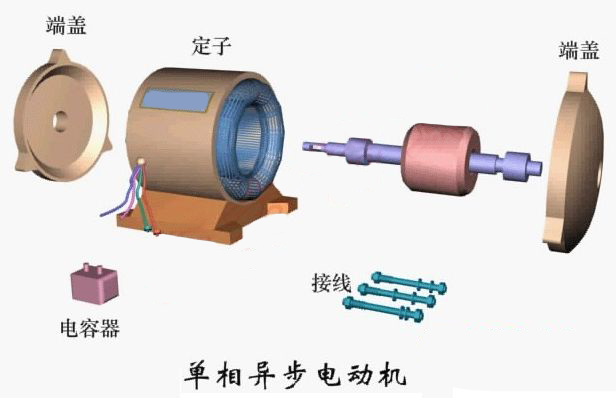
1. Machine base
The structure of the machine base varies depending on the cooling method, protection type, installation method, and purpose of the motor. According to their material classification, there are several types such as cast iron, cast aluminum, and steel plate structures.
Cast iron machine base with heat dissipation ribs. The machine base is connected to the end cover and fastened with bolts.
Aluminum casting machine bases generally do not have heat dissipation ribs.
The steel plate structure machine base is made by rolling and welding thin steel plates with a thickness of 1.5-2.5 millimeters, and then welding the bottom feet of the steel plate stamping parts.
Some specialized electric motors have quite special bases, such as the electric motor of a refrigerator, which is usually packed together with the compressor in a sealed container. The electric motors of washing machines, including those of spin dryers, have no mounts and end caps directly fixed to the stator iron core.
2. Iron core
The iron core includes the stator iron core and the rotor iron core, which function similarly to a three-phase asynchronous motor and are used to form the magnetic circuit of the motor.
3. Winding
The stator winding of a single-phase asynchronous motor is often made into two phases: the main winding (working winding) and the auxiliary winding (starting winding). The central axes of the two windings are offset by a certain electrical angle. The purpose is to improve startup and operational performance. The stator winding is often wound with high-strength polyester enameled wire.
The rotor winding generally adopts cage winding. It is commonly made by aluminum die-casting.
4. End cap
Corresponding to different machine base materials and end caps, there are also cast iron parts, cast aluminum parts, and steel plate stamping parts.
5. Bearing
There are ball bearings and oil containing bearings.
6. Centrifugal switch or starter relay and PTC starter
(1) Centrifugal switch
In single-phase asynchronous motors, in addition to capacitor operated motors, during the starting process, when the rotor speed reaches about 70% of the synchronous speed, centrifugal switches are often used to cut off the starting windings of single-phase resistance starting asynchronous motors and capacitor starting asynchronous motors, or to cut off the starting capacitors of capacitor starting and operating asynchronous motors. Centrifugal switches are generally installed on the inside of the shaft extension end cover.
(2) Starting relay
Some electric motors, such as refrigerator motors, are assembled with compressors and placed in sealed jars, making it difficult to install centrifugal switches. Therefore, starting relays are used instead. The iron suction coil of the relay is connected in series in the main winding circuit. When starting, the main winding current is high, and the armature moves, causing the dynamic contact points connected in series in the secondary winding circuit to close. So the secondary winding is connected, and the motor is in a two-phase winding operation state. As the rotor speed increases, the main winding current continuously decreases, and the suction force of the attraction coil decreases. When a certain speed is reached, the suction force of the electromagnet is less than the tension of the reaction spring of the contact, and the contact is opened, and the secondary winding is disconnected from the power supply.
(3) PTC starter
The latest starting element is "PTC", which is a thermistor that can "turn on" or "turn off". PTC thermistor is a new type of semiconductor component that can be used as a delay type starting switch. When in use, connect the PTC element in series with the secondary winding of the capacitor or resistor starter motor. In the initial stage of starting, due to the PTC thermistor not yet heating up and having a low resistance value, the secondary winding is in a circuit state, and the motor begins to start. As time goes by, the speed of the motor continues to increase, and the temperature of the PTC element rises due to its own Joule heating. When it exceeds the Curie point Tc (the temperature point where the resistance increases sharply), the resistance sharply increases, and the secondary winding circuit is equivalent to breaking, but there is still a small holding current and 2-3 watts of loss, which keeps the temperature of the PTC element above the Curie point Tc value. After the motor stops running, the temperature of the PTC component continuously decreases, and its resistance value drops below the Tc point for about 2-3 minutes. At this time, it can be restarted, which happens to be the shutdown time between the two startups specified for the refrigerator and air conditioner.
The advantages of PTC starter: contactless, reliable operation, no noise or electric sparks, good fire and explosion resistance. And it is resistant to vibration, impact, small in size, light in weight, and low in price.
7. Nameplate
Including: motor name, model, standard number, manufacturer name, factory number, rated voltage, rated power, rated current, rated speed, winding connection, insulation level, etc.
2、 Working principle of single-phase asynchronous motor
When three-phase AC power is applied to the stator three-phase winding of a three-phase asynchronous motor, a rotating magnetic field is formed. Under the action of the rotating magnetic field, the rotor will obtain the starting torque and start on its own. When a three-phase asynchronous motor is supplied with single-phase AC power, it cannot generate a rotating magnetic field.
Let's analyze the magnetic field generated when single-phase AC power is applied to the stator winding of a single-phase asynchronous motor. The schematic diagram of a simple single-phase asynchronous motor is shown below, with single-phase stator windings arranged on the stator core and a squirrel cage structure for the rotor.
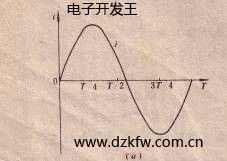
AC current waveform
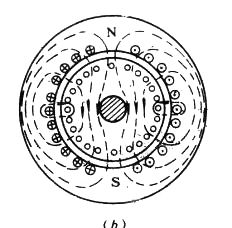
The magnetic field generated by the positive half cycle of the current
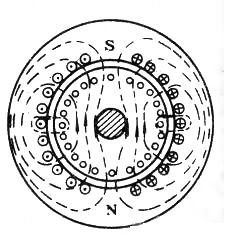
The magnetic field generated by the negative half cycle of the current
When single-phase AC power is introduced into the stator winding of a single-phase asynchronous motor, as shown in the above figure, when the current continuously alternates between the positive and negative half cycles, the magnitude and direction of the magnetic field generated also change continuously (according to the sine law), but the axis of the magnetic field remains fixed along the longitudinal axis. This type of magnetic field is called a pulsating magnetic field.
When the rotor is stationary, the synthesized induced electromotive force and current of the rotor conductor are 0, and the synthesized torque is 0, so the rotor has no starting torque. If certain measures are not taken for single-phase asynchronous motors, they cannot start on their own. If an external force is used to rotate the rotor, it can continue to rotate in that direction.
Reducer,Gear motor,electric machinery,motor
Address: No.66 bis, Hetong Road, Dongfeng Town, Zhongshan City, Guangdong Province
Tel:0760-22189558
Mobile:13923325827

©2023 GUANGDONG YONGKUN MOTOR CO.,LTD All rights reserved


