Basic Structure of Servo Motor - Diagram of Working Principle of Servo Motor
Release Time :
2024-10-22
Source :
network
Author:
Made by Guangdong Yongkun Motor Co., Ltd
The function of a servo motor is to convert the input voltage signal (i.e. control voltage) into angular displacement or angular velocity output on the shaft. It is often used as an actuator in automatic control systems, so servo motors are also known as executive motors
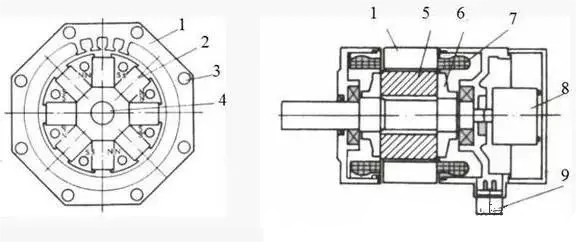
Mainly composed of stator 1, rotor 5, and detection element 8, etc
When there is no control voltage, the AC servo motor only has a pulsating magnetic field generated by the excitation winding in the air gap, and the rotor is stationary without starting torque. When there is a control voltage and the control winding current is different from the excitation winding current, a rotating magnetic field is generated in the air gap and electromagnetic torque is generated, causing the rotor to rotate in the direction of the rotating magnetic field. But the requirement for servo motors is not only that they can be started under the control voltage, but also that the motor should be able to stop immediately after the voltage disappears. If the control voltage of the servo motor disappears and continues to rotate like a typical single-phase asynchronous motor, a loss of control phenomenon occurs. We call this phenomenon of self rotation due to loss of control self rotation.
Control method
Metaphysics can use the following three methods to control the speed and direction of rotation of servo motors.
(1) Amplitude control maintains the phase difference between the control voltage and the excitation voltage unchanged, only changing the amplitude of the control voltage.
(2) Phase control maintains the amplitude of the control voltage unchanged, only changing the phase difference between the control voltage and the excitation voltage.
(3) Amplitude phase control simultaneously changes the amplitude and phase of the control voltage.
The basic working principle of traditional DC servo motors is exactly the same as that of ordinary DC motors, which rely on the action of armature current and air gap flux to generate electromagnetic torque and make the servo motor rotate. The armature control method is usually used, which adjusts the speed by changing the armature voltage while keeping the excitation voltage constant. The smaller the armature voltage, the lower the rotational speed; When the armature voltage is zero, the motor stops running. Since the armature voltage is zero and the armature current is also zero, the motor does not generate electromagnetic torque and does not experience "self rotation".
servo motor ,Variable speed motor,electric machinery
Address: No.66 bis, Hetong Road, Dongfeng Town, Zhongshan City, Guangdong Province
Tel:0760-22189558
Mobile:13923325827

©2023 GUANGDONG YONGKUN MOTOR CO.,LTD All rights reserved


