
Why do single-phase motors need capacitors? What is its function?
Release Time :
2024-11-01
Source :
NETWORK
Author:
Made by Guangdong Yongkun Motor Co., Ltd
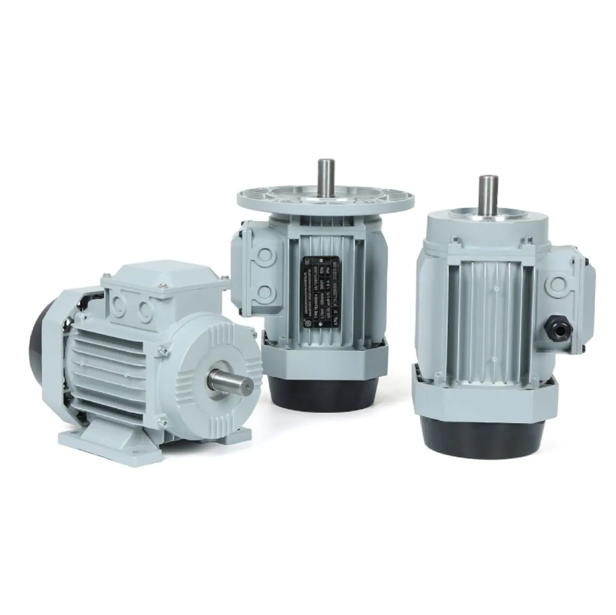
A single-phase motor generally refers to a low-power single-phase asynchronous motor powered by a single-phase AC power source (AC220V). This type of motor usually has two-phase windings on the stator and a common squirrel cage rotor. The distribution of two-phase windings on the stator and the different power supply conditions can produce different starting and operating characteristics.
The main purpose of adding capacitors to single-phase motors is to achieve starting and improve power factor. The following will discuss in detail the role of capacitors in single-phase motors.
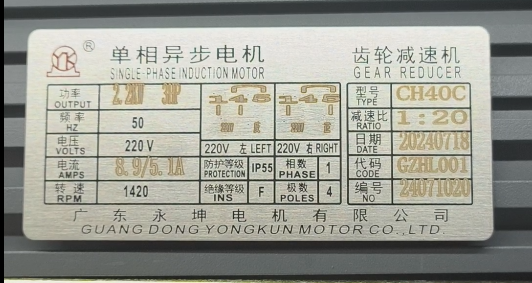
A single-phase motor rotates due to the interaction between a magnetic field generated by a main current passing through the stator and a magnetic field generated by a secondary current passing through the winding. Due to the fact that a single-phase power supply only provides one power phase, it cannot directly generate a rotating magnetic field. Therefore, in order to start the single-phase motor, we need to take some additional measures. Adding capacitors is one common method.
The specific functions are as follows:
1. Generate phase difference: The capacitor can generate a phase difference through its capacitive reaction (i.e. the charging and discharging process of the capacitor), which allows the motor's starting torque to be generated. When a single-phase motor is started, adding a capacitor can achieve the difference in rotational speed between the two magnetic fields, thereby providing sufficient starting force for the motor.
2. Improve power factor: Single phase motors typically have lower power factor (i.e. power factor). Power factor is an indicator that describes the phase difference between current and voltage. If the power factor is low, the efficiency of the motor will decrease, resulting in a significant waste of electrical energy. By adding capacitors, the power factor of single-phase motors can be improved. Capacitors provide additional reactive power to offset the inductive reactive power of single-phase motors, thereby improving power factor and enhancing motor efficiency.
3. Balanced power supply: Single phase motors generate significant harmonic currents in the power grid during operation, increasing the load on the grid. By adding capacitors, these harmonic currents can be partially offset, reducing the load on the power grid and maintaining its stable operation.
4. Reduce oscillation: Due to the single-phase motor having only one power phase, its torque will fluctuate over time. By adding capacitors, oscillations during motor operation can be reduced. The function of capacitors is similar to that of buffers, which can smooth the working state of motors and reduce oscillations.
5. Increasing starting torque: Adding capacitors can increase the starting torque of single-phase motors and improve their starting ability. During the start-up process, capacitors provide additional reactive power, increasing the rotating magnetic field of the motor and thus improving the starting torque.
It should be noted that adding capacitors requires a reasonable selection based on the rated power and voltage of the single-phase motor. Improper selection or use of inappropriate capacitors may result in difficulty starting, unstable operation, and even motor burnout. Therefore, when selecting and using capacitors, please be sure to follow the relevant technical specifications and safety guidelines.
Three phase asynchronous AC motor,Three phase motor,Gear motor
Address: No.66 bis, Hetong Road, Dongfeng Town, Zhongshan City, Guangdong Province
Tel:0760-22189558
Mobile:13923325827

©2023 GUANGDONG YONGKUN MOTOR CO.,LTD All rights reserved


